


Porsche "Variable turbine geometry"


Porsche "Variable turbine geometry"

nice... I wonder what they use to alter the angle of the blades... mechanized? or mechnical? I suspect a weighted method that as the air fllow increasess the angles decrease to "catch" more air.

Banned
Joined: Feb 2010
Posts: 1,436
Likes: 50
Banned
Joined: Feb 2010
Posts: 1,436
Likes: 50
Check out the videos in this link. The vtg and the expansive intake manifold are very impressive.
http://www.porsche.com/usa/models/91...l/?gtabindex=2


yea its pretty cool i was into diesel trucks befor i got my G and the new duramax diesel have the vvt turbos on them its nice you get that low end boost of a small turbo and then the top end of a big one...
Banned
Joined: Feb 2010
Posts: 1,436
Likes: 50
? for both turbo tim and Dmattei, you guys have any idea about the longevity of these type of turbos? Not sure how those electronic motors that adjust the vains hold up with all that heat.
Trending Topics
Variable Turbine Geometry technology is the next generation in turbocharger technology where the turbo uses variable vanes to control exhaust flow against the turbine blades. See, the problem with the turbocharger that we’ve all come to know and love is that big turbos do not work well at slow engine speeds, while small turbos are fast to spool but run out of steam pretty quick. So how do VTG turbos solve this problem?
A Variable Turbine Geometry turbocharger is also known as a variable geometry turbocharger (VGT), or a Variable Nozzle Turbine (VNT). A turbocharger equipped with Variable Turbine Geometry has little movable vanes which can direct exhaust flow onto the turbine blades. The vane angles are adjusted via an actuator. The angle of the vanes vary throughout the engine RPM range to optimize turbine behaviour.
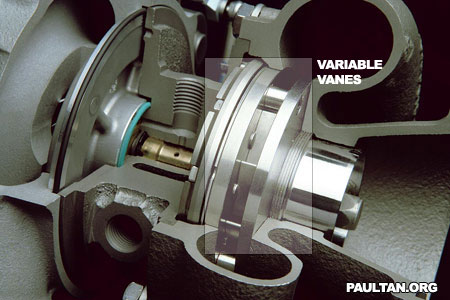
In the 3D illustration above, you can see the vanes in a angle which is almost closed. I have highlighted the variable vanes so you know which is which. This position is optimized for low engine RPM speeds, pre-boost.
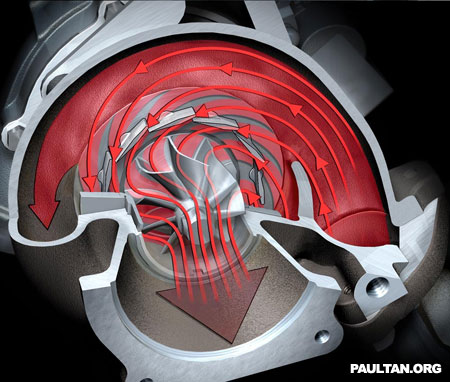
In this cut-through diagram, you can see the direction of exhaust flow when the variable vanes are in an almost closed angle. The narrow passage of which the exhaust gas has to flow through accelerates the exhaust gas towards the turbine blades, making them spin faster. The angle of the vanes also directs the gas to hit the blades at the proper angle.

Above are how the VGT vanes look like when they are open. I’ve not highlighted where the vanes are in this image since you already know where they are, as to not spoil the mechanical beauty that it is
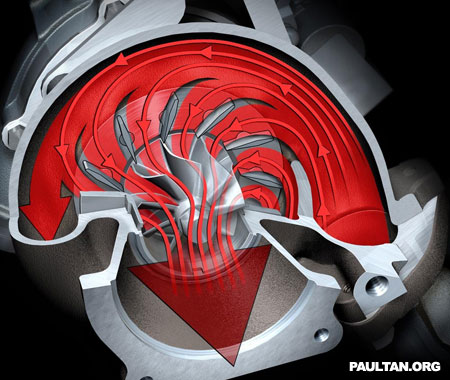
This cut-through diagram shows the exhaust gas flow when the variable turbine vanes are fully open. The high exhaust flow at high engine speeds are fully directed onto the turbine blades by the variable vanes.
Variable Turbine Geometry has been used extensively in turbodiesel engines since the 1990s, but it has never been on a production petrol turbocharged car before until the new Type 997 Porsche 911 Turbo. This is because petrol engine exhaust gases are alot hotter than diesel engine exhaust gas, so generally the material used to make VTG turbos could not stand this heat. The 997 911 Turbo uses a BorgWarner VTG turbocharger which uses special materials derived from aerospace technology, hence solving the temperature problem.
I hope I have helped you understand how VTG works. Watch out for full tech details on the new Porsche 911 Turbo.
A Variable Turbine Geometry turbocharger is also known as a variable geometry turbocharger (VGT), or a Variable Nozzle Turbine (VNT). A turbocharger equipped with Variable Turbine Geometry has little movable vanes which can direct exhaust flow onto the turbine blades. The vane angles are adjusted via an actuator. The angle of the vanes vary throughout the engine RPM range to optimize turbine behaviour.
In the 3D illustration above, you can see the vanes in a angle which is almost closed. I have highlighted the variable vanes so you know which is which. This position is optimized for low engine RPM speeds, pre-boost.
In this cut-through diagram, you can see the direction of exhaust flow when the variable vanes are in an almost closed angle. The narrow passage of which the exhaust gas has to flow through accelerates the exhaust gas towards the turbine blades, making them spin faster. The angle of the vanes also directs the gas to hit the blades at the proper angle.
Above are how the VGT vanes look like when they are open. I’ve not highlighted where the vanes are in this image since you already know where they are, as to not spoil the mechanical beauty that it is
This cut-through diagram shows the exhaust gas flow when the variable turbine vanes are fully open. The high exhaust flow at high engine speeds are fully directed onto the turbine blades by the variable vanes.
Variable Turbine Geometry has been used extensively in turbodiesel engines since the 1990s, but it has never been on a production petrol turbocharged car before until the new Type 997 Porsche 911 Turbo. This is because petrol engine exhaust gases are alot hotter than diesel engine exhaust gas, so generally the material used to make VTG turbos could not stand this heat. The 997 911 Turbo uses a BorgWarner VTG turbocharger which uses special materials derived from aerospace technology, hence solving the temperature problem.
I hope I have helped you understand how VTG works. Watch out for full tech details on the new Porsche 911 Turbo.
Banned
Joined: Feb 2010
Posts: 1,436
Likes: 50
I said it was a repost because your link goes to the gt2 rs. I had previously posted that. But the discussion of the vtg turbos specifically, is a good topic to discuss.
This last post of yours explaining the VTG is very good. I still want to find some info on how the vains are actually controlled however. The vtg video on porsche website said that the vains are controlled by electro motors. But finding specs on this is difficult.
This last post of yours explaining the VTG is very good. I still want to find some info on how the vains are actually controlled however. The vtg video on porsche website said that the vains are controlled by electro motors. But finding specs on this is difficult.
Last edited by abcdo4dkIdjkm; Jun 26, 2010 at 10:48 AM.
i think if im not mistaken on the diesels they are mechanical boost regulates it and as far as price gotta be upwards of 2000+ starting considering a regular turbo for the diesel range from 1500-2800 for just a drop in replacement thats on the diesels atleast
Banned
Joined: Feb 2010
Posts: 1,436
Likes: 50
^^^Ya the vtg video on the porsche website said electronic controlled motors adjust the vains. You were right, they are expensive I just looked them up on the oem porsche website. They are 3,400$ each brand new and 2,000$ each remanufactured.
I said it was a repost because your link goes to the gt2 rs. I had previously posted that. But the discussion of the vtg turbos specifically, is a good topic to discuss.
This last post of yours explaining the VTG is very good. I still want to find some info on how the vains are actually controlled however. The vtg video on porsche website said that the vains are controlled by electro motors. But finding specs on this is difficult.
This last post of yours explaining the VTG is very good. I still want to find some info on how the vains are actually controlled however. The vtg video on porsche website said that the vains are controlled by electro motors. But finding specs on this is difficult.
to me this would sound more desirable since Diesel dose use high compression and a lot of tq.
BTW dont forget about the mani which goes with these turbos too.. $$$$