


VTG.. I luv this topic..


VTG.. I luv this topic..
Variable Turbine Geometry (VTG)

The 911 Turbo and 911 Turbo S models are straightforward, almost matter-of-fact, when it comes to handling power. VTG has contributed enormously to this.
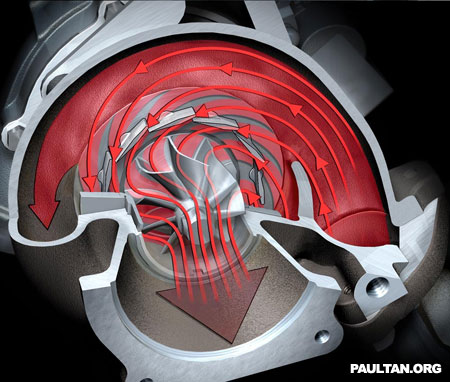
The variable turbine geometry of the twin water-cooled exhaust gas turbochargers goes a long way to resolving the conflict of aims of normal turbochargers. With this technology, the gas flow from the engine is channelled onto the turbines via electronically adjustable guide vanes. By changing the vane angle, the system can replicate the geometry in all types of turbo, large or small, and thus achieve the optimum gas-flow characteristics. The guide vanes are controlled by the engine management system.
The result is a high turbine speed – and therefore higher boost pressure – even at low engine rpm. With more air available, the combustion is increased, yielding greater power and torque. Maximum torque is reached at lower rpm and is retained across a wider rev range. Both engine variants deliver a torque of just 650 Nm from as low as 1,950 rpm. In the case of the 911 Turbo models, this torque is available up to 5,000 rpm. The increased maximum torque of 700 Nm in the 911 Turbo S models is available between 2,100 rpm and 4,250 rpm.
When the boost pressure reaches its maximum value, the guide vanes are opened further. By varying the vane angle, it is possible to achieve the required boost pressure over the entire engine speed range. As a result, there is no need for excess-pressure valves as found on conventional turbocharged engines.
In the 911 Turbo models, engine performance can be further enhanced by selecting the SPORT button on the optional Sport Chrono Package Turbo. Under full acceleration, the maximum boost pressure in the lower and medium speed ranges is temporarily increased by approximately 0.2 bar. As a result, engine torque is temporarily boosted by 50 Nm to a maximum of 700 Nm. The 911 Turbo S models, by contrast, are configured to operate with a higher boost pressure level, which means that their maximum torque of 700 Nm is available for an unlimited period.
These values are sure to impress. Yet, combined with the fuel economy achieved despite the high power output, they are even more impressive. Because power alone is not enough.
The 911 Turbo and 911 Turbo S models are straightforward, almost matter-of-fact, when it comes to handling power. VTG has contributed enormously to this.
The variable turbine geometry of the twin water-cooled exhaust gas turbochargers goes a long way to resolving the conflict of aims of normal turbochargers. With this technology, the gas flow from the engine is channelled onto the turbines via electronically adjustable guide vanes. By changing the vane angle, the system can replicate the geometry in all types of turbo, large or small, and thus achieve the optimum gas-flow characteristics. The guide vanes are controlled by the engine management system.
The result is a high turbine speed – and therefore higher boost pressure – even at low engine rpm. With more air available, the combustion is increased, yielding greater power and torque. Maximum torque is reached at lower rpm and is retained across a wider rev range. Both engine variants deliver a torque of just 650 Nm from as low as 1,950 rpm. In the case of the 911 Turbo models, this torque is available up to 5,000 rpm. The increased maximum torque of 700 Nm in the 911 Turbo S models is available between 2,100 rpm and 4,250 rpm.
When the boost pressure reaches its maximum value, the guide vanes are opened further. By varying the vane angle, it is possible to achieve the required boost pressure over the entire engine speed range. As a result, there is no need for excess-pressure valves as found on conventional turbocharged engines.
In the 911 Turbo models, engine performance can be further enhanced by selecting the SPORT button on the optional Sport Chrono Package Turbo. Under full acceleration, the maximum boost pressure in the lower and medium speed ranges is temporarily increased by approximately 0.2 bar. As a result, engine torque is temporarily boosted by 50 Nm to a maximum of 700 Nm. The 911 Turbo S models, by contrast, are configured to operate with a higher boost pressure level, which means that their maximum torque of 700 Nm is available for an unlimited period.
These values are sure to impress. Yet, combined with the fuel economy achieved despite the high power output, they are even more impressive. Because power alone is not enough.

Thread
Thread Starter
Forum
Replies
Last Post
edindaclub
G35 Coupe V35 2003 - 07
6
Jan 30, 2007 05:49 AM
Brian-g35
G35 Coupe V35 2003 - 07
4
Apr 20, 2006 08:30 AM