


Look What I Got Today!


Oh jesus. The misinformation about HIDs is astounding. I hate to be the raincloud on your guy's parade but this needs to be addressed:
Higher Kelvin lights, ie >4300k lighting DOES NOT equal higher light output, in fact its quite the opposite. Blacklights are very high K color and provide NO useful light...that is the principle of higher K HIDs. Nifty colors at the expense of output and safety...
Well written guide:
Essentially at 5k you can be at 90% of normal 4300k output, get rid of the yellow and have nearly normal performance. 6k is also doable, but again expect 20-30% loss, maybe more with crappy bulbs.
8k or higher is essentially 50-60+% loss of lumen output if not even more...that is retarded IMO. You need headlights to see...at night this type of lighting is useless and a hazard to you and other drivers.
Higher Kelvin lights, ie >4300k lighting DOES NOT equal higher light output, in fact its quite the opposite. Blacklights are very high K color and provide NO useful light...that is the principle of higher K HIDs. Nifty colors at the expense of output and safety...
Well written guide:
It's become apparent that there are a lot of people who go out and buy HID's without knowing what they are getting into. Basically, they are throwing cash away. So hopefully this thread helps.
Projector vs Reflector
Now, as some of of you may have noticed there are a few of us that tend to complain to many members about putting HID's in factory halogen reflector housings. Most of you don't understand why.... maybe this will help.
First lets compare the light output.
Your factory halogen system is anywhere from 550 lumens to 1100 lumens.
HID kits range from 1200-3500 lumens; the 4300k bulbs being the most light output, and the purpley 10000+k systems dipping down to 1200 lumens.
It's easy to see here, that a decent HID kit will produce nearly 3 times the light as a regular bulb.
Now, lets compare the housings.
Reflector housing are made to push the light in one direction. They do the job, but you can't control all of the light output of a bulb. You can get glare at the ends of the output light. It's caused by scattered light hitting a point on the reflector, that it wasn't supposed to hit.
See the left image below.
Projectors, on the other hand, take all of the reflected light, and focus it on to a projection lens. This controls the end of the output a bit better... The disadvantage though, is that a projector will put out light on in the upper directions as well. A cut off shield prevents this. It limits how much light is sent to the top of the lens.
See the right image below.

Now, what is glare?
The glare I refer to is a beam of light directly hitting a persons eye.
I'm not talking about looking at the beam from a side or any of that... I mean right at the eye.
The reflective glare from some lights is similar to looking directly into the headlights.
Now I hope we all understand why we don't put HID's in reflector housings.
If you haven't got the point yet, here it is in simple terms.
After a conversion, your light will be 3 times brighter.... so will the glare.
Glare is what causes 'sun spots' in people eyes at night. A headlight light can cause reduced visibility for a while, but a very bright glare can actually temporarily blind a person. Not good if your the other driver.
What about cars that have OEM HID reflectors?
Yes, some cars, such as Lexus IS300's come from factory with HID's in reflector housings. We have to understand a few key points about this though.
1) The housings are specially designed for HID's, as to optimally cut down on HID glare. These aren't just your everyday run of the mill housing. Although they don't have a sharp cut off, they control where the light is being emitted to.
2) They use special bulbs; D2R. The D2R bulb has certain sections painted out on the bulb to reduce certain problematic glare areas. Also, D2R bulbs produce less light than the bulbs found in projectors.
How does this affect me?
Do you want to be the cause of an accident? Didn't think so.
There have been numerous reports in the across the US and Canada of accidents being caused by temporary blindness. What do you think was the cause? PnP HID kits.
Now it's a matter of time before the cops start cracking down on this.... and I sure hope they do.
Then what is the right way to do it?
Projector housings, or better yet, a retrofit.
You can buy projector headlights for under $250 now. They have dedicated low beam projectors, with pretty good cut offs in them. They are available from many retailers, and even on eBay.
A retro fit is indeed the best option. It basically consists of taking apart your headlights, and hacking the reflector housing to fit in a projector from a dedicated HID vehicle, like a TSX, FX35/45, or a BMW. It's actually the cheaper route in the end, but takes a lot of time. A retro can take anywhere from 12-26 hours of work, and many more hours of planning. Most retro's cost about $150-$200, plus the HID kit (bulbs and ballasts).
On a separate positive note, many newer factory HID projector are 'bi-xenon'. They have an adjustable cut off, to allow hi and lo functions on HID. Ex) Infiniti FX34/45.
So, that's the bottom line.
If you are still hell bent on a PnP ghetto kit, that's your deal.... but don't cry if something bad happens. (I've heard stories ranging from 'the cops ticketed me' to 'some angry motorist smashed my headlights')
Bulbs
It's apparent that many people have a misconception about bulbs, lumens, and kelvin.So, lets clear this up right now. The higher the Kelvin, the less light output you get (lumens).
With that said, anything over 6000K is basically a waste.
So, what is the best bulb? IMO the 4300K is the best, as it has the highest light output. The problem, though, is that they have a yellow-ish tinge to them that some people find un-attractive. In that case, 5000-6000k is a better choice for you..... as they have a more blue look to them.
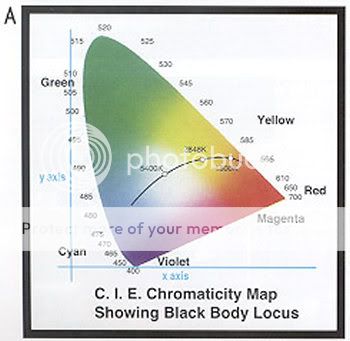
As you can see below, 4100k has almost the same color output as natural daylight.


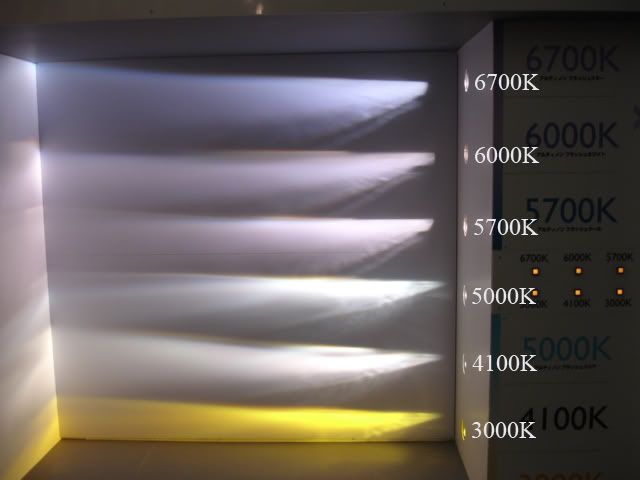
And a comparison of Kelvin to lumens;
Standard OEM halogen 55W 9006(HB4) = 1100lm (lumens)
4300k D2S Philips = 3200lm (lumens)
4300k D2R Philips = 2800lm (lumens)
4300k D2S Philips = 2400lm (lumens) actually 5800k
4300k D2R Philips = 2000lm (lumens) actually 5800k
4800k D4S/R (brand) = 3800 (lumens) -- brightest in the market
5800k D4S/R (brand) = 3300 (lumens)
7000k D2S other = 1790lm (lumens) *(other bulb brand)
7000k D2R other = 1390lm (lumens) *(other bulb brand)
8000k D2S other = 1180lm (lumens) *(other bulb brand)
8000k D2R other = 780lm (lumens) *(other bulb brand)
Higher than 8000k, the light output significantly drops off, causing the light to be almost useless. The perfect example is a black light that is around 15k or more and has ZERO useable light...this is where you trend to past the 4300k peak output.
One should point out that although light output drops off after 8000k, the fact that the light is in the blue-purple spectrum, it still puts a major strain on the eyes of others.
Projector vs Reflector
Now, as some of of you may have noticed there are a few of us that tend to complain to many members about putting HID's in factory halogen reflector housings. Most of you don't understand why.... maybe this will help.
First lets compare the light output.
Your factory halogen system is anywhere from 550 lumens to 1100 lumens.
HID kits range from 1200-3500 lumens; the 4300k bulbs being the most light output, and the purpley 10000+k systems dipping down to 1200 lumens.
It's easy to see here, that a decent HID kit will produce nearly 3 times the light as a regular bulb.
Now, lets compare the housings.
Reflector housing are made to push the light in one direction. They do the job, but you can't control all of the light output of a bulb. You can get glare at the ends of the output light. It's caused by scattered light hitting a point on the reflector, that it wasn't supposed to hit.
See the left image below.
Projectors, on the other hand, take all of the reflected light, and focus it on to a projection lens. This controls the end of the output a bit better... The disadvantage though, is that a projector will put out light on in the upper directions as well. A cut off shield prevents this. It limits how much light is sent to the top of the lens.
See the right image below.
Now, what is glare?
The glare I refer to is a beam of light directly hitting a persons eye.
I'm not talking about looking at the beam from a side or any of that... I mean right at the eye.
The reflective glare from some lights is similar to looking directly into the headlights.
Now I hope we all understand why we don't put HID's in reflector housings.
If you haven't got the point yet, here it is in simple terms.
After a conversion, your light will be 3 times brighter.... so will the glare.
Glare is what causes 'sun spots' in people eyes at night. A headlight light can cause reduced visibility for a while, but a very bright glare can actually temporarily blind a person. Not good if your the other driver.
What about cars that have OEM HID reflectors?
Yes, some cars, such as Lexus IS300's come from factory with HID's in reflector housings. We have to understand a few key points about this though.
1) The housings are specially designed for HID's, as to optimally cut down on HID glare. These aren't just your everyday run of the mill housing. Although they don't have a sharp cut off, they control where the light is being emitted to.
2) They use special bulbs; D2R. The D2R bulb has certain sections painted out on the bulb to reduce certain problematic glare areas. Also, D2R bulbs produce less light than the bulbs found in projectors.
How does this affect me?
Do you want to be the cause of an accident? Didn't think so.
There have been numerous reports in the across the US and Canada of accidents being caused by temporary blindness. What do you think was the cause? PnP HID kits.
Now it's a matter of time before the cops start cracking down on this.... and I sure hope they do.
Then what is the right way to do it?
Projector housings, or better yet, a retrofit.
You can buy projector headlights for under $250 now. They have dedicated low beam projectors, with pretty good cut offs in them. They are available from many retailers, and even on eBay.
A retro fit is indeed the best option. It basically consists of taking apart your headlights, and hacking the reflector housing to fit in a projector from a dedicated HID vehicle, like a TSX, FX35/45, or a BMW. It's actually the cheaper route in the end, but takes a lot of time. A retro can take anywhere from 12-26 hours of work, and many more hours of planning. Most retro's cost about $150-$200, plus the HID kit (bulbs and ballasts).
On a separate positive note, many newer factory HID projector are 'bi-xenon'. They have an adjustable cut off, to allow hi and lo functions on HID. Ex) Infiniti FX34/45.
So, that's the bottom line.
If you are still hell bent on a PnP ghetto kit, that's your deal.... but don't cry if something bad happens. (I've heard stories ranging from 'the cops ticketed me' to 'some angry motorist smashed my headlights')
Bulbs
It's apparent that many people have a misconception about bulbs, lumens, and kelvin.So, lets clear this up right now. The higher the Kelvin, the less light output you get (lumens).
With that said, anything over 6000K is basically a waste.
So, what is the best bulb? IMO the 4300K is the best, as it has the highest light output. The problem, though, is that they have a yellow-ish tinge to them that some people find un-attractive. In that case, 5000-6000k is a better choice for you..... as they have a more blue look to them.
As you can see below, 4100k has almost the same color output as natural daylight.
And a comparison of Kelvin to lumens;
Standard OEM halogen 55W 9006(HB4) = 1100lm (lumens)
4300k D2S Philips = 3200lm (lumens)
4300k D2R Philips = 2800lm (lumens)
4300k D2S Philips = 2400lm (lumens) actually 5800k
4300k D2R Philips = 2000lm (lumens) actually 5800k
4800k D4S/R (brand) = 3800 (lumens) -- brightest in the market
5800k D4S/R (brand) = 3300 (lumens)
7000k D2S other = 1790lm (lumens) *(other bulb brand)
7000k D2R other = 1390lm (lumens) *(other bulb brand)
8000k D2S other = 1180lm (lumens) *(other bulb brand)
8000k D2R other = 780lm (lumens) *(other bulb brand)
Higher than 8000k, the light output significantly drops off, causing the light to be almost useless. The perfect example is a black light that is around 15k or more and has ZERO useable light...this is where you trend to past the 4300k peak output.
One should point out that although light output drops off after 8000k, the fact that the light is in the blue-purple spectrum, it still puts a major strain on the eyes of others.
8k or higher is essentially 50-60+% loss of lumen output if not even more...that is retarded IMO. You need headlights to see...at night this type of lighting is useless and a hazard to you and other drivers.
Last edited by stradaONE8; May 4, 2010 at 12:34 AM.
^^agreed thank you for the info. It really cleared things up. I may end up progressing back to the 4-5K bulbs. For now I am just extremely happy with the projectors becasue now I can actually see at night...which is a huge plus
So, Dr. ****, with my lower headlight bulb (fog light), can u reccomend a bulb that will be whiter or even bluer than the stock one I have that has a yellow hue to it? I read the discussion about the K of the bulbs, I am just asking if u know a particular manufacturer of said bulb....any preferences?
well you go more yellow the further below 4300 you go, and more white into blue into purple the higher above 4300 you go... i don't think you can go more white/blue and more yellow, they both go in opposite directions... 4300 is the happy median here

My Berk Technology test pipes just came in!! 
http://www.flickr.com/photos/43973500@N07/4580569402/
http://www.flickr.com/photos/43973500@N07/4580564348/
Ill probably install them with my headers this week if im not too busy.
http://www.flickr.com/photos/43973500@N07/4580569402/
http://www.flickr.com/photos/43973500@N07/4580564348/
Ill probably install them with my headers this week if im not too busy.