


Help with audio... =D thanks


Thread Starter
|
Registered User
Joined: Mar 2009
Posts: 1
Likes: 0
Help with audio... =D thanks
What sup guys,
I tired to search this but I didn't see anything about it. I just got my 2005 G35 coupe. I was wondering the specs on the audio. Speaker sizes and all that good stuff. Thanks ladies and gents. =D
 if you have this info...
I tired to search this but I didn't see anything about it. I just got my 2005 G35 coupe. I was wondering the specs on the audio. Speaker sizes and all that good stuff. Thanks ladies and gents. =D
if you have this info...



Registered User
Joined: Jul 2006
Posts: 734
Likes: 1
From: Sunny CA
If they are the stock speakers, don't worry about wattage, it is not much, but you don't need it. If you upgrade the speakers, most anything good you get will be rated at much higher power handling.
Only be concerned if you plan to put a big amp in there, then you will not want to keep the stock speakers anyway.
Only be concerned if you plan to put a big amp in there, then you will not want to keep the stock speakers anyway.


something I've searched for in the past, took me awhile to find but it's the closest thing for the coupe....
My best guess is...222watts total(it says RMS but probably peak power) divide by 6 speakers(the description says 8 speakers but don't count the tweeters which probably shares the power with the 6.5 speakers on the front doors with some passive crossovers somewhere).....
divided evenly through each speakers which is 37 watts peak per channel. RMS is probably half of that which 18-19 watts RMS per channel. If that 222watts is indeed RMS, then just roughly double the 18-19 watts to 36-38 watts RMS per channel. Yeah...it sucks.
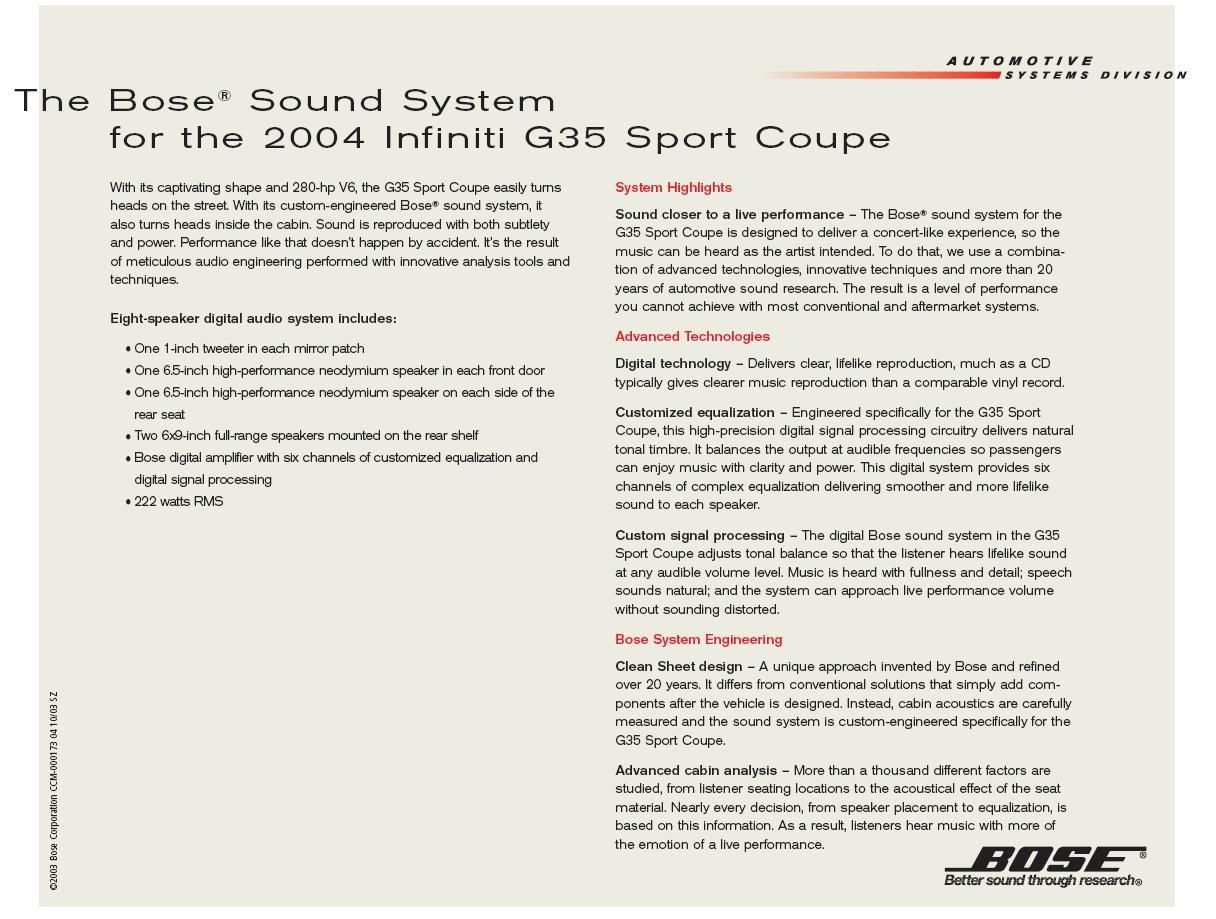
My best guess is...222watts total(it says RMS but probably peak power) divide by 6 speakers(the description says 8 speakers but don't count the tweeters which probably shares the power with the 6.5 speakers on the front doors with some passive crossovers somewhere).....
divided evenly through each speakers which is 37 watts peak per channel. RMS is probably half of that which 18-19 watts RMS per channel. If that 222watts is indeed RMS, then just roughly double the 18-19 watts to 36-38 watts RMS per channel. Yeah...it sucks.
Last edited by Deezflip; Sep 26, 2009 at 09:39 AM.

Registered User
Joined: Sep 2009
Posts: 665
Likes: 4
something I've searched for in the past, took me awhile to find but it's the closest thing for the coupe....
My best guess is...222watts total(it says RMS but probably peak power) divide by 6 speakers(the description says 8 speakers but don't count the tweeters which probably shares the power with the 6.5 speakers on the front doors with some passive crossovers somewhere).....
divided evenly through each speakers which is 37 watts peak per channel. RMS is probably half of that which 18-19 watts RMS per channel. If that 222watts is indeed RMS, then just roughly double the 18-19 watts to 36-38 watts RMS per channel. Yeah...it sucks.
My best guess is...222watts total(it says RMS but probably peak power) divide by 6 speakers(the description says 8 speakers but don't count the tweeters which probably shares the power with the 6.5 speakers on the front doors with some passive crossovers somewhere).....
divided evenly through each speakers which is 37 watts peak per channel. RMS is probably half of that which 18-19 watts RMS per channel. If that 222watts is indeed RMS, then just roughly double the 18-19 watts to 36-38 watts RMS per channel. Yeah...it sucks.
But in any case you have the math incorrect for peak power. It would not be half for peak it would be .707 .
If peak to peak then it would be 1.414 . In amplifiers however there is a lot of question if one should be using rms at all since it is applied in incorrect ways. Some use it as 1.414 of absolute peak to peak, others use it as 1.414 of peak to peak at rated distortion levels, but in any case rms itself is really not meant to be used for audio purpose largely due to the type of loads present.
Trending Topics
Registered User
Joined: Jul 2006
Posts: 734
Likes: 1
From: Sunny CA
Lots of hype for mediocre delivery..but probably a little better than stock.
Low impedance quality speaker upgrades especially for the front door speakers is the first stage of improvement.
Replacing them all and getting a good amp is the best way to go of course.
Low impedance quality speaker upgrades especially for the front door speakers is the first stage of improvement.
Replacing them all and getting a good amp is the best way to go of course.

I would believe the 220 rms unless proven otherwise since this would be a big deal for false advertisement claims.
But in any case you have the math incorrect for peak power. It would not be half for peak it would be .707 .
If peak to peak then it would be 1.414 . In amplifiers however there is a lot of question if one should be using rms at all since it is applied in incorrect ways. Some use it as 1.414 of absolute peak to peak, others use it as 1.414 of peak to peak at rated distortion levels, but in any case rms itself is really not meant to be used for audio purpose largely due to the type of loads present.
But in any case you have the math incorrect for peak power. It would not be half for peak it would be .707 .
If peak to peak then it would be 1.414 . In amplifiers however there is a lot of question if one should be using rms at all since it is applied in incorrect ways. Some use it as 1.414 of absolute peak to peak, others use it as 1.414 of peak to peak at rated distortion levels, but in any case rms itself is really not meant to be used for audio purpose largely due to the type of loads present.

Anyways, the OP and others asked for specs and wattage of the bose system, not advice nor the importance of RMS and peak. I gave them a rough ballpark figure. I'm sure they already know the bose is not impressive at all, regardless of its specifications.
Registered User
Joined: Sep 2009
Posts: 665
Likes: 4
I'm sure this is correct and all, but I never understood why some speakers from roughly 10yrs ago had ratings in where the RMS usually ends up being half of the peak
Anyways, the OP and others asked for specs and wattage of the bose system, not advice nor the importance of RMS and peak. I gave them a rough ballpark figure. I'm sure they already know the bose is not impressive at all, regardless of its specifications.
Anyways, the OP and others asked for specs and wattage of the bose system, not advice nor the importance of RMS and peak. I gave them a rough ballpark figure. I'm sure they already know the bose is not impressive at all, regardless of its specifications.
I think the confusion you may have seen from 10 years ago actually goes back far longer. Manufactures had peak, peak to peak, music power, rms, etc. Then they had the same listings at rated distortion levels and so on. I think right now most treat the rms value in basically the same way (even though it really doesn't apply) so you are probably safe making a purchase based on it. I haven't had my Infiniti apart to look at it but on some cars the rating is printed on the speaker itself so may well be worth a look.

Registered User
Joined: Mar 2009
Posts: 84
Likes: 0
From: Austin, TX
The door speakers have a model number, no identifying wattage labels ('05 Coupe). Just looking at the design of the speaker and the magnet size it doesnt appear to be able to hold very much wattage at all. ~30 watts max I would say. The 6x9's in the back are a little more solid. So if the system is advertised as 220 watts, my assumption would be 30 watts each to the front and rear 6.5" speaker and 50 watts each for the 6x9's giving a total of 220 watts at 2 ohms. Now whether that is watts or RMS rating, I am not certain.
Registered User
Joined: Sep 2009
Posts: 665
Likes: 4
The door speakers have a model number, no identifying wattage labels ('05 Coupe). Just looking at the design of the speaker and the magnet size it doesnt appear to be able to hold very much wattage at all. ~30 watts max I would say. The 6x9's in the back are a little more solid. So if the system is advertised as 220 watts, my assumption would be 30 watts each to the front and rear 6.5" speaker and 50 watts each for the 6x9's giving a total of 220 watts at 2 ohms. Now whether that is watts or RMS rating, I am not certain.
I peg them at 45 watts to the 4 speakers and about 22.5 to the other two. This is why I figure this. My assumption is the stock amp doesn't use a dc to dc converter for rail voltage. Because of this then the normal high value would be about 22.5 watts for a push pull transistor arraignment or double that if bridged outputs. The actual output would be dictated by battery voltage. You will often see this in many aftermarket head units with built in amplifiers. So if running 4 bridged outputs you end up with 180 watts which leaves you close to the values (40 watts) for the other two.

Thread
Thread Starter
Forum
Replies
Last Post
