


Compression Rod Bushing Pin Holes


Joined: Nov 2004
Posts: 17,181
Likes: 154
From: OC - So Cal
 Compression Rod Bushing Pin Holes
I think I may have just found the reason for the compression rods failure.
Its common knowledge that it’s the bushing that fails… and relatively common knowledge that the TSB (technical service bulletin, for those that don’t know) instructs dealer to replace bushing not entire rod.
When this problem first started (prior to TSB) the dealer would replace the entire arm under warranty (I had mine replaced as have countless of others out here)… but Nissan got smart and decided to stop wasting money on the whole rod when its just the bushing that needs replacing… but IMO, they weren’t very smart in not determining why the bushings keep going bad.
I currently have the notorious “clunk” and decided to order bushings (thanks Riverside Infiniti for great price and fast shipment!) – I got one for each side, even though its only driver side that is bad right now.
When I received the part I took a good look… I had not previously inspected the bushing in close detail – prior warranty work I didn’t even see the part… and current condition has only been observed on the car.
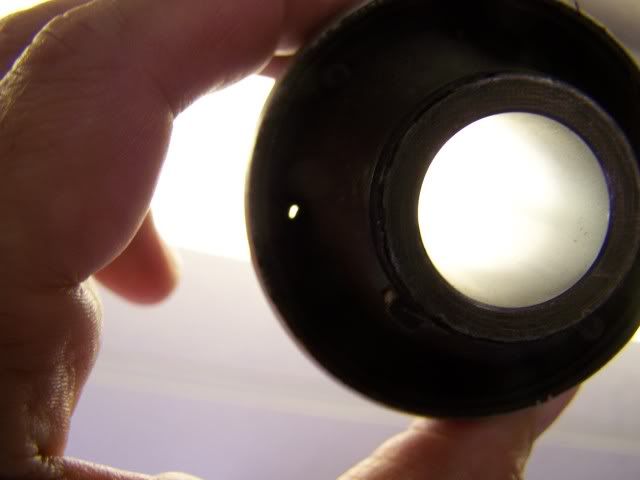
For those that are unfamiliar with the bushing – it’s a typical rubber style - set in an aluminum housing and has a metal bore in the center for mounting… when I looked closely, I noticed the rubber has seams around the edge on each side – The seams are part of the manufacturing process of course, but on the two bushing I have there are tiny pin holes… one is very visible, the other has two trifling holes that are barely visible.
It is my theory that these holes eventually turn into tears (as in rip, not cry) which lead to the metal on metal contact and “clunk”… something so simple that stricter manufacturing controls should be able to eliminate. All manufacturing have tolerances and its possible that some bushing get through with no pins holes… this might explain why not everyone has the problem… but of course enough of us do have the problem – so if this is the cause apparently many are being sent out with pin holes.
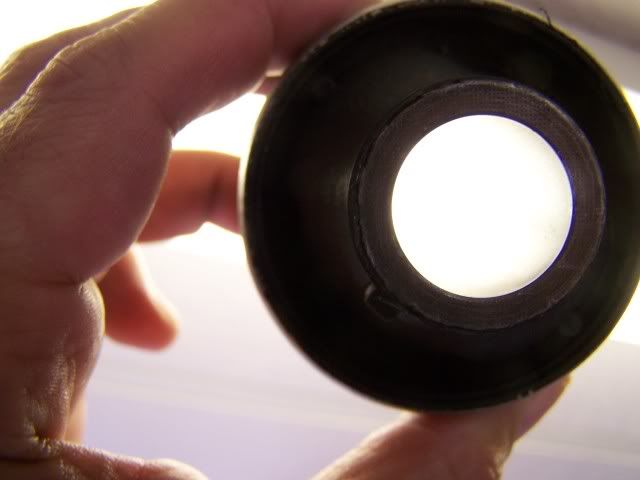
I took some pics to show you what I am referencing… the first pic shows light coming through the hole… the 2nd pic is the exact same bushing, same angle but with my finger covering the pin hole form the other side so no light shows through… the other bushing’s pin holes are too small to capture easily on cam, they are easily detectable with the naked eye. In these pics you dont see the seam - the hole you see is at the end of the seam.
So – instead of sending these back and possibly getting more pin holes, I’m going to install and see how long they last… but I’m hoping that future bushing purchasers will take a look and see if theirs have pin holes – and maybe over time we will determine if indeed the ones with holes are the ones that are failing.
Then there's always the possibility that these holes cause zero problems... I'll take a good look at my old bushings when removed... if the "crack"/tear looks like it started where the seam is - then I bet this is the problem.
Pin Hole:
Covering Pin Hole:
Its common knowledge that it’s the bushing that fails… and relatively common knowledge that the TSB (technical service bulletin, for those that don’t know) instructs dealer to replace bushing not entire rod.
When this problem first started (prior to TSB) the dealer would replace the entire arm under warranty (I had mine replaced as have countless of others out here)… but Nissan got smart and decided to stop wasting money on the whole rod when its just the bushing that needs replacing… but IMO, they weren’t very smart in not determining why the bushings keep going bad.
I currently have the notorious “clunk” and decided to order bushings (thanks Riverside Infiniti for great price and fast shipment!) – I got one for each side, even though its only driver side that is bad right now.
When I received the part I took a good look… I had not previously inspected the bushing in close detail – prior warranty work I didn’t even see the part… and current condition has only been observed on the car.
For those that are unfamiliar with the bushing – it’s a typical rubber style - set in an aluminum housing and has a metal bore in the center for mounting… when I looked closely, I noticed the rubber has seams around the edge on each side – The seams are part of the manufacturing process of course, but on the two bushing I have there are tiny pin holes… one is very visible, the other has two trifling holes that are barely visible.
It is my theory that these holes eventually turn into tears (as in rip, not cry) which lead to the metal on metal contact and “clunk”… something so simple that stricter manufacturing controls should be able to eliminate. All manufacturing have tolerances and its possible that some bushing get through with no pins holes… this might explain why not everyone has the problem… but of course enough of us do have the problem – so if this is the cause apparently many are being sent out with pin holes.
I took some pics to show you what I am referencing… the first pic shows light coming through the hole… the 2nd pic is the exact same bushing, same angle but with my finger covering the pin hole form the other side so no light shows through… the other bushing’s pin holes are too small to capture easily on cam, they are easily detectable with the naked eye. In these pics you dont see the seam - the hole you see is at the end of the seam.
So – instead of sending these back and possibly getting more pin holes, I’m going to install and see how long they last… but I’m hoping that future bushing purchasers will take a look and see if theirs have pin holes – and maybe over time we will determine if indeed the ones with holes are the ones that are failing.
Then there's always the possibility that these holes cause zero problems... I'll take a good look at my old bushings when removed... if the "crack"/tear looks like it started where the seam is - then I bet this is the problem.
Pin Hole:
Covering Pin Hole:
Last edited by OCG35; Aug 19, 2009 at 07:18 PM.

I just check mine that I'm about to install and they have the same tiny holes. I don't think they are a defect but just part of the revision. If you got to compare them with the old ones you'll see they redesigned the bushing in a way that 1/4 of the rubber is not there anymore. On the other hand they thickened the other 3/4 of the inner rubber. Now, the question is where to point this section with almost no rubber... I mean, the thicker sides should point when in the rod to the engine or to the fenders?
Joined: Nov 2004
Posts: 17,181
Likes: 154
From: OC - So Cal
Temple City Auto installed mine and John made a good point - to orient the thicker part of the rubber were the majority of torsion occurs.
BTW, while I agree that the pinholes are simply part of the manufacturing process - it's in no way purposeful for any benefit… time will tell if it is a fatigue point.
BTW, while I agree that the pinholes are simply part of the manufacturing process - it's in no way purposeful for any benefit… time will tell if it is a fatigue point.
Well before pressing the compression rod bushing I checked the placement of it on a picture I found in the forum and actually the bushing have a mark (circled in red below) that aim to the ball joint on the other end. When we take out the compression rod and compared to the picture it matched so we just pressed the revised bushing following this mark.

On the non-revised bushing the section that have the pin holes is totally missing any rubber at all. I believe they are definitely, like you said, part of the manufacturing process.
On the non-revised bushing the section that have the pin holes is totally missing any rubber at all. I believe they are definitely, like you said, part of the manufacturing process.
Last edited by mesias; Sep 1, 2009 at 10:31 PM. Reason: typo

Thread
Thread Starter
Forum
Replies
Last Post
FS[NorEast]: New OEM G35x Compression Rods - Save!!
The Fixer
Steering & Suspension
15
Nov 1, 2015 03:26 PM
