


G37 Dyno Up on Automobilemag.com 50+ HP


Originally Posted by muscarel
In terms of comparisions with the M3, the M3 weighs less and the gearing seems more aggressive, at least in 1st gear. Final drive ratio is almost the same, but look at the 1st gear ratio of the M3 compared to 3.79 of the G37. G37 tire size is also a 1/2 inch taller:
1st Gear Ratio 4.23:1
2nd Gear Ratio 2.53:1
3rd Gear Ratio 1.67:1
4th Gear Ratio 1.23:1
5th Gear Ratio 1.00:1
6th Gear Ratio 0.83:1
Final Drive Ratio 3.62:1
That being said, it's nice that Infiniti could produce an engine with similar characteristics as that of the E46 M3. Then again, BMW did it with a 3.2 liter engine.
1st Gear Ratio 4.23:1
2nd Gear Ratio 2.53:1
3rd Gear Ratio 1.67:1
4th Gear Ratio 1.23:1
5th Gear Ratio 1.00:1
6th Gear Ratio 0.83:1
Final Drive Ratio 3.62:1
That being said, it's nice that Infiniti could produce an engine with similar characteristics as that of the E46 M3. Then again, BMW did it with a 3.2 liter engine.

Registered User
Joined: Jan 2003
Posts: 971
Likes: 1
From: Caribbean
Originally Posted by muscarel
Here's mine. The setup is a bit confusing but you get the idea.

looking at your sheet, i used the 19" wheels on the 335i but the #s should be very similar. glancing over the #s you have, it looks like mine are within 5hp or so.
question: in 1st gear, the HP should be 3-4x the dyno #s, since the tq is being multiplied on the ground (at 3-4x the effective ratio of 5th gear) and as a result, hp is being multiplied as well right?
also, im assuming the F/D is input into the dyno so it knows what to divide by to get back to the correct whp at the given gear ratio (1:1, 5th gear on these cars)..is this correct?

Originally Posted by tekknikal
i redid my sheet, but the #s are very high.. not sure if my math is right on compensating for gearing
looking at your sheet, i used the 19" wheels on the 335i but the #s should be very similar. glancing over the #s you have, it looks like mine are within 5hp or so.
question: in 1st gear, the HP should be 3-4x the dyno #s, since the tq is being multiplied on the ground (at 3-4x the effective ratio of 5th gear) and as a result, hp is being multiplied as well right?
also, im assuming the F/D is input into the dyno so it knows what to divide by to get back to the correct whp at the given gear ratio (1:1, 5th gear on these cars)..is this correct?
looking at your sheet, i used the 19" wheels on the 335i but the #s should be very similar. glancing over the #s you have, it looks like mine are within 5hp or so.
question: in 1st gear, the HP should be 3-4x the dyno #s, since the tq is being multiplied on the ground (at 3-4x the effective ratio of 5th gear) and as a result, hp is being multiplied as well right?
also, im assuming the F/D is input into the dyno so it knows what to divide by to get back to the correct whp at the given gear ratio (1:1, 5th gear on these cars)..is this correct?
As for entering the FD into the dyno, you don't have to for dynojets(I don't know about others). The dynojets monitor rpms by picking up the signal to the coil packs. The dynojet computer also knows the speed of the drum. Using those two figures, one can derive a total to-the-drum gearing ratio, which includes the the gear ratio, FD, and tire circumference/tire height.
If you play around with the Winpep software, you can see the calculated gear ratio as long as your x-axis is engine speed. One thing that is interesting to note is observing the gear ratios changing from one run to another; I imagine it's tires heating up.
Registered User
Joined: Jan 2003
Posts: 971
Likes: 1
From: Caribbean
actually i just figured out the mistake- the hp vs speed doesnt matter. the tq vs speed is what matters because at any instant (=speed), tq on the ground is what accelerates you. ill be updating my chart accordingly.
Registered User
Joined: Jan 2003
Posts: 971
Likes: 1
From: Caribbean
alright here we go again.
these are fixed, gear adjusted charts that take into account shifting through gears & holding gears to redline.
im assuming dyno runs were done @ 1:1 gearing.
these should fairly accurately compare the force each car is being propelled by as speeds increase...

EDIT=This is inaccurate. See my post with ver 6 graphs for details
i think the chart pretty much speaks for itself :/
im looking for more errors, but they arent apparent to me...
had infiniti done what they should have, and offered a 3.9FD, the situation would have been little different. the G comes closer but the 335 has advantages at certain pts. it would be 'easy' to mod a G to beat a 335 but according to this, the 335 seems to have the advantage from the beginning.
but then the 335 can go chipped, and all bets would definitely be off.
comments/questions welcome.
these are fixed, gear adjusted charts that take into account shifting through gears & holding gears to redline.
im assuming dyno runs were done @ 1:1 gearing.
these should fairly accurately compare the force each car is being propelled by as speeds increase...
EDIT=This is inaccurate. See my post with ver 6 graphs for details
i think the chart pretty much speaks for itself :/
im looking for more errors, but they arent apparent to me...
had infiniti done what they should have, and offered a 3.9FD, the situation would have been little different. the G comes closer but the 335 has advantages at certain pts. it would be 'easy' to mod a G to beat a 335 but according to this, the 335 seems to have the advantage from the beginning.
but then the 335 can go chipped, and all bets would definitely be off.
comments/questions welcome.
Last edited by tekknikal; Jun 11, 2007 at 12:54 PM.

Registered User
Joined: Mar 2003
Posts: 688
Likes: 0
^^ I hope this doesn't start another torque vs. hp war.
Can we skip the debate and maybe see the chart with HP vs. Speed? I'd appreciate the exercise.
The only thing that matters is horsepower. In terms of acceleration, 200 lb-ft of torque at 2000 rpm is NOT equal to 200 lb-ft of torque at 8,000 rpm. I think Fast1 may be the only person who disagrees with these facts. One easy example to see this is a mototrcyle that has a FLAT torque curve from almost off idle to redline. Anyone that drives a motorcycle knows that you get much more acceleration near redline than you do at 1,000 rpm. That's because the Horsepower is probably 10x greater at 10,000 rpm as it is at 1,000 rpm. Same torque remember.
The chart is not indicative of acceleration, because atthe same MPH, the G37 may be 1,000 rpm higher which means that it could have 20% more HP given the same torque.
This is not to say torque is not important. More torque means more HP at the same rpm. It's just saying that torque AND rpm are both important. Knowing both, you can see how much horsepower is produced (HP = Torque x rpm/5252). The part of the equation that is missing is RPM. The higher the rpm, the more power is produced and thus more acceleration.
Can we skip the debate and maybe see the chart with HP vs. Speed? I'd appreciate the exercise.
The only thing that matters is horsepower. In terms of acceleration, 200 lb-ft of torque at 2000 rpm is NOT equal to 200 lb-ft of torque at 8,000 rpm. I think Fast1 may be the only person who disagrees with these facts. One easy example to see this is a mototrcyle that has a FLAT torque curve from almost off idle to redline. Anyone that drives a motorcycle knows that you get much more acceleration near redline than you do at 1,000 rpm. That's because the Horsepower is probably 10x greater at 10,000 rpm as it is at 1,000 rpm. Same torque remember.
The chart is not indicative of acceleration, because atthe same MPH, the G37 may be 1,000 rpm higher which means that it could have 20% more HP given the same torque.
This is not to say torque is not important. More torque means more HP at the same rpm. It's just saying that torque AND rpm are both important. Knowing both, you can see how much horsepower is produced (HP = Torque x rpm/5252). The part of the equation that is missing is RPM. The higher the rpm, the more power is produced and thus more acceleration.
Last edited by muscarel; Jun 7, 2007 at 06:14 PM.
Registered User
Joined: Mar 2003
Posts: 688
Likes: 0
Originally Posted by tekknikal
looking at your sheet, i used the 19" wheels on the 335i but the #s should be very similar. glancing over the #s you have, it looks like mine are within 5hp or so.
Registered User
Joined: Jan 2003
Posts: 971
Likes: 1
From: Caribbean
Originally Posted by muscarel
The 335 doesn't come with 19" tires. The tire sizes I entered are what you get with the sport package.
Registered User
Joined: Jan 2003
Posts: 971
Likes: 1
From: Caribbean
Originally Posted by muscarel
^^ I hope this doesn't start another torque vs. hp war.
Can we skip the debate and maybe see the chart with HP vs. Speed? I'd appreciate the exercise.
 if you want to know the acceleration of a mass, the equation would be A=F/M, so you'd want force if possible...
The only thing that matters is horsepower. In terms of acceleration, 200 lb-ft of torque at 2000 rpm is NOT equal to 200 lb-ft of torque at 8,000 rpm. I think Fast1 may be the only person who disagrees with these facts. One easy example to see this is a mototrcyle that has a FLAT torque curve from almost off idle to redline. Anyone that drives a motorcycle knows that you get much more acceleration near redline than you do at 1,000 rpm. That's because the Horsepower is probably 10x greater at 10,000 rpm as it is at 1,000 rpm. Same torque remember.
getting to your analogy, you're right that given a flat tq curve the bike will pull hardest up top- but you could say that's because gearing can be utilized.
The chart is not indicative of acceleration, because atthe same MPH, the G37 may be 1,000 rpm higher which means that it could have 20% more HP given the same torque.
regarding the methods used to compute each series, i basically did the following for each car (off the top of my head, dont have my sheet in front of me):
-calculate the engine rpm at each 5mph speed increment. after redline is reached i go to the next gear. data used to calculate this includes gearing+final drive+tire diameter,etc
-find the wheel tq at each speed increment using dyno data
-using gearing, calculate final wheel tq produced
im sure i missed some things, but thats the jist of it. anyway as you can see your concern was accounted for from the very beginning.
This is not to say torque is not important. More torque means more HP at the same rpm. It's just saying that torque AND rpm are both important. Knowing both, you can see how much horsepower is produced (HP = Torque x rpm/5252). The part of the equation that is missing is RPM. The higher the rpm, the more power is produced and thus more acceleration.
on the flip side bmw wasn't too agressive with the boost, it tapers near redline- causing the large decline in hp/tq. had they held boost the car would have been a lot quicker without pulling any harder.
i definitely dont consider this to be a closed case however, simply because im not sure how accurate these dynos are. iirc the 335i tends to dyno 270-275whp, and that 10whp makes a difference. also, where these dynos done at the same day/same conditions? the printouts measure increments differently, leading me to suspect the answer is no.
regardless with the data we have at this point it does appear the 335 has an advantage. we'll see what happens when the new g comes though
Registered User
Joined: Jan 2003
Posts: 971
Likes: 1
From: Caribbean
Originally Posted by muscarel
Gotcha. Are you planning on posting the revised horsepower vs. speed chart? I think it would really paint a good picture of the 2 cars.
Registered User
Joined: Mar 2003
Posts: 688
Likes: 0
Originally Posted by tekknikal
i posted something on the last page... some said that gearing should be taken into account. i agree. but, at the same time, how do you determine how a car accelerates vs speed? you do so by looking at the rpm the vehicle is at and calculate how much force (wtq) can be applied to propel it at that rpm. its pretty 'easy' to calculate that, so i did. getting back to a hp expression though, what does it mean to measure hp on the ground at every speed? horsepower is a measure of the ability to do work over time. knowing hp on the ground at every speed doesnt seem to make sense if you want to know the acceleration of a mass, the equation would be A=F/M, so you'd want force if possible...
if you want to know the acceleration of a mass, the equation would be A=F/M, so you'd want force if possible...http://www.howstuffworks.com/horsepower1.htm
"Another thing you can see from a car's horsepower curve is the place where the engine has maximum power. When you are trying to accelerate quickly, you want to try to keep the engine close to its maximum horsepower point on the curve. That is why you often downshift to accelerate -- by downshifting, you increase engine rpm, which typically moves you closer to the peak horsepower point on the curve. If you want to "launch" your car from a traffic light, you would typically rev the engine to get the engine right at its peak horsepower rpm and then release the clutch to dump maximum power to the tires."
Originally Posted by tekknikal
getting to your analogy, you're right that given a flat tq curve the bike will pull hardest up top- but you could say that's because gearing can be utilized.
Also, look at F1 cars. They only make about 200 lb-ft of torque yet as we all know they are extremely fast - BUT they rely on high rpm to make all that power and accelerate faster.
Her's another site that explains the F=MA part you mentioned.
http://www.mustangsandmore.com/ubb/D...orqueVsHP.html
"It's the torque applied by the tires
to
the ground that actually accelerates a car, not the torque generated by the
engine. Horsepower, being the rate at which torque is produced, is an
indicator of how much *potential* torque multiplication is available. In
other words, horsepower describes how much engine rpm can be traded for tire
torque. The word "potential" is important here. If a car is not geared
properly, it will be unable to take full advantage of the engine's
horsepower.
Ideally, a continuously variable transmission which holds rpm at an engine's
horsepower peak, would yield the best possible acceleration. "
Lastly, look at CVT transmissions. They hold rpm at peak horsepower, not torque. That kind of sums it all up.
I hope the above is enough for you to put together the original chart.
Originally Posted by tekknikal
infiniti wasnt too agressive with their gearing (the g37 is less agressively geared than the 03-04 6mt for instance)
Registered User
Joined: Jan 2003
Posts: 971
Likes: 1
From: Caribbean
Originally Posted by trey.hutcheson
Could you please explain further?
i should have been more accurate.
the gearing on the g37 is definitely more agressive than the gearing on the earlier g35s.
but, altough you get 1000 more rpms before redline, the powerband hasnt shifted by the same amount per se, if that makes sense. and you spend more time in every gear. i admit the issue may be trivial and i would imagine nissan did what they did for economy... but to be clear the gearing is numerically higher on the g37.
muscarel,
I read through what you wrote. a lot of it is in line with what i understand, and i believe we're talking about the same thing from different points of view. some parts however, im not sure i agree with. for isntance:
BUt I'm talking about within the same gear. FOr instance in first gear, the ratio remains constant. A motorcyle with a flat torque curve continues to accelerate harder and harder as rpm risers, although torque remains constant. The gearing is no different at 10,000 rpm in 1st gear as it is at 1,000 rpm.
also, isn't it true that looking at maximum horsepower and maximum transmission output tq are really amounting to looking for the same thing?
i know the difference between hp and tq, but consider: the max tranny output tq is going to be greater at the hp peak in one gear than at any point in the next gear (assuming proper gearing). as you noted with cvt, if you had cvt you'd keep it near redline since F=P*V so for max force you want to maximize power vs speed. if, with a cvt tranny, the engine were held at max tq, you'd see lower power because p=t*rpm...and therefore, lower force.
in any case i completely reworked the charts..improving things such as usdm 335i tires, 335i data accuracy, etc.
Aslo, conceptually, so far as i know- the transmission does not multiply power. it multiplies torque. power is kept constant through the system.
what im somewhat unsure about though, is what is meant by torque on these dynosheets. since power is constant, you can assume it's measuring power after drivetrain loss. but torque can change depending on gear and where you're measuring. however, on sheets like this they dont give you the gear that they test in. furthermore afaik dynojet determines tq from hp. therefore im thinking that the tq seen is the crank tq adjusted for drivetrain loss.
combined, this gives us a different picture. i believe this is more accurate. i still dont think that the hp vs speed graph has an easily understood meaning.. but i included it below for you to check out. the story, i think, is most easily told by the final torque on the ground vs speed.
if you think any of this is wrong, let me know...

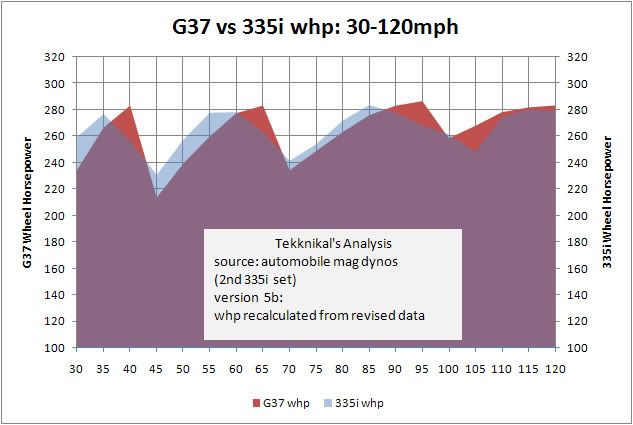
looking at chart 1, i think the picture is self explanatory again. as the cars accelerate, the vq37 seems to be pushing the G forward with more force than the n54 on the 335i. even though the 335i has more torque, the g37's torque curve is flatter, going up to higher rpms, thereby allowing the car to run a more aggressive gearing resulting in more force on the ground to be propelled by.
Last edited by tekknikal; Jun 11, 2007 at 12:56 PM.