


G37 Dyno Up on Automobilemag.com 50+ HP



Originally Posted by tekknikal
i should have been more accurate.
the gearing on the g37 is definitely more agressive than the gearing on the earlier g35s.
but, altough you get 1000 more rpms before redline, the powerband hasnt shifted by the same amount per se, if that makes sense. and you spend more time in every gear. i admit the issue may be trivial and i would imagine nissan did what they did for economy... but to be clear the gearing is numerically higher on the g37.
the gearing on the g37 is definitely more agressive than the gearing on the earlier g35s.
but, altough you get 1000 more rpms before redline, the powerband hasnt shifted by the same amount per se, if that makes sense. and you spend more time in every gear. i admit the issue may be trivial and i would imagine nissan did what they did for economy... but to be clear the gearing is numerically higher on the g37.
The ability to stay in gear longer, due to the higher redline, is a huge benefit, as long as the power doesn't taper off too quickly. I believe the shift points for gears 1-4 are still at redline, so that's a good thing.

Registered User
Joined: Jan 2003
Posts: 971
Likes: 1
From: Caribbean
Originally Posted by trey.hutcheson
That was my confusion. The gear ratios are identical between the generations, but the FD has been shortened, on the order of 5% for the 6 speed.
The ability to stay in gear longer, due to the higher redline, is a huge benefit, as long as the power doesn't taper off too quickly. I believe the shift points for gears 1-4 are still at redline, so that's a good thing.
The ability to stay in gear longer, due to the higher redline, is a huge benefit, as long as the power doesn't taper off too quickly. I believe the shift points for gears 1-4 are still at redline, so that's a good thing.

Registered User
Joined: Mar 2003
Posts: 688
Likes: 0
Originally Posted by tekknikal
i should have been more accurate.
the gearing on the g37 is definitely more agressive than the gearing on the earlier g35s.
but, altough you get 1000 more rpms before redline, the powerband hasnt shifted by the same amount per se, if that makes sense. and you spend more time in every gear. i admit the issue may be trivial and i would imagine nissan did what they did for economy... but to be clear the gearing is numerically higher on the g37.
muscarel,
I read through what you wrote. a lot of it is in line with what i understand, and i believe we're talking about the same thing from different points of view. some parts however, im not sure i agree with. for isntance:
within any gear, maximum acceleration occurs at peak torque. do you disagree?
also, isn't it true that looking at maximum horsepower and maximum transmission output tq are really amounting to looking for the same thing?
i know the difference between hp and tq, but consider: the max tranny output tq is going to be greater at the hp peak in one gear than at any point in the next gear (assuming proper gearing). as you noted with cvt, if you had cvt you'd keep it near redline since F=P/V so for max force you want to maximize power over speed. if, with a cvt tranny, the engine were held at max tq, you'd see lower power because p=t*rpm...and therefore, lower force.
in any case i completely reworked the charts..improving things such as usdm 335i tires, 335i data accuracy, etc.
Aslo, conceptually, so far as i know- the transmission does not multiply power. it multiplies torque. power is kept constant through the system.
what im somewhat unsure about though, is what is meant by torque on these dynosheets. since power is constant, you can assume it's measuring power after drivetrain loss. but torque can change depending on gear and where you're measuring. however, on sheets like this they dont give you the gear that they test in. furthermore afaik dynojet determines tq from hp. therefore im thinking that the tq seen is the crank tq adjusted for drivetrain loss.
combined, this gives us a different picture. i believe this is more accurate. i still dont think that the hp vs speed graph has an easily understood meaning.. but i included it below for you to check out. the story, i think, is most easily told by the final torque on the ground vs speed.
if you think any of this is wrong, let me know...

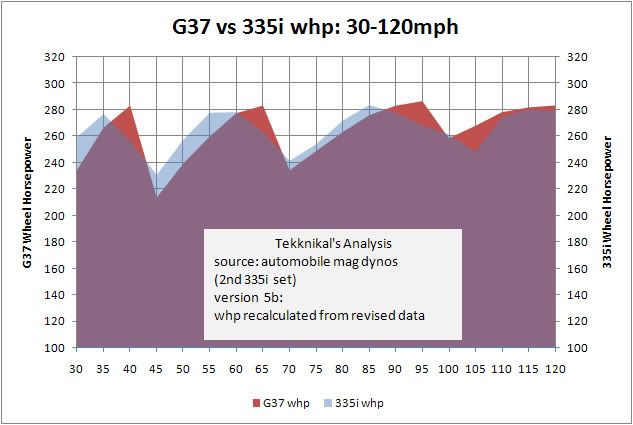
looking at chart 1, i think the picture is self explanatory again. as the cars accelerate, the vq37 seems to be pushing the G forward with more force than the n54 on the 335i. even though the 335i has more torque, the g37's torque curve is flatter, going up to higher rpms, thereby allowing the car to run a more aggressive gearing resulting in more force on the ground to be propelled by.
the gearing on the g37 is definitely more agressive than the gearing on the earlier g35s.
but, altough you get 1000 more rpms before redline, the powerband hasnt shifted by the same amount per se, if that makes sense. and you spend more time in every gear. i admit the issue may be trivial and i would imagine nissan did what they did for economy... but to be clear the gearing is numerically higher on the g37.
muscarel,
I read through what you wrote. a lot of it is in line with what i understand, and i believe we're talking about the same thing from different points of view. some parts however, im not sure i agree with. for isntance:
within any gear, maximum acceleration occurs at peak torque. do you disagree?
also, isn't it true that looking at maximum horsepower and maximum transmission output tq are really amounting to looking for the same thing?
i know the difference between hp and tq, but consider: the max tranny output tq is going to be greater at the hp peak in one gear than at any point in the next gear (assuming proper gearing). as you noted with cvt, if you had cvt you'd keep it near redline since F=P/V so for max force you want to maximize power over speed. if, with a cvt tranny, the engine were held at max tq, you'd see lower power because p=t*rpm...and therefore, lower force.
in any case i completely reworked the charts..improving things such as usdm 335i tires, 335i data accuracy, etc.
Aslo, conceptually, so far as i know- the transmission does not multiply power. it multiplies torque. power is kept constant through the system.
what im somewhat unsure about though, is what is meant by torque on these dynosheets. since power is constant, you can assume it's measuring power after drivetrain loss. but torque can change depending on gear and where you're measuring. however, on sheets like this they dont give you the gear that they test in. furthermore afaik dynojet determines tq from hp. therefore im thinking that the tq seen is the crank tq adjusted for drivetrain loss.
combined, this gives us a different picture. i believe this is more accurate. i still dont think that the hp vs speed graph has an easily understood meaning.. but i included it below for you to check out. the story, i think, is most easily told by the final torque on the ground vs speed.
if you think any of this is wrong, let me know...
looking at chart 1, i think the picture is self explanatory again. as the cars accelerate, the vq37 seems to be pushing the G forward with more force than the n54 on the 335i. even though the 335i has more torque, the g37's torque curve is flatter, going up to higher rpms, thereby allowing the car to run a more aggressive gearing resulting in more force on the ground to be propelled by.
I'm a little confused now, but I appreciate the Hp vs. speed chart. The only thing missing is to take that chart and apply the torque multiplicaiton to it. But I'll take it. Thanks for all the work.
When the first test results come out, let's compare the 0-40, 40-60, 60-80, and 80-100 times of these 2 cars. Assuming gearing is similar in these 2 cars as is the weight, I say that the HP vs. speed graph will be a good representation of the acceleration differences. The G37 seems to have the advantage once the speeds rise above 80 mph. 0-40 goes to the 335. Not sure if the G37 will have enough time to catch it by the 1/4 mile. Either way, these cars won't be that far off from each other.
We'll know soon enough.

Registered User
Joined: Jan 2003
Posts: 971
Likes: 1
From: Caribbean
Originally Posted by muscarel
I'm a little confused now, but I appreciate the Hp vs. speed chart. The only thing missing is to take that chart and apply the torque multiplicaiton to it. But I'll take it. Thanks for all the work.
When the first test results come out, let's compare the 0-40, 40-60, 60-80, and 80-100 times of these 2 cars. Assuming gearing is similar in these 2 cars as is the weight, I say that the HP vs. speed graph will be a good representation of the acceleration differences. The G37 seems to have the advantage once the speeds rise above 80 mph. 0-40 goes to the 335. Not sure if the G37 will have enough time to catch it by the 1/4 mile. Either way, these cars won't be that far off from each other.
We'll know soon enough.
When the first test results come out, let's compare the 0-40, 40-60, 60-80, and 80-100 times of these 2 cars. Assuming gearing is similar in these 2 cars as is the weight, I say that the HP vs. speed graph will be a good representation of the acceleration differences. The G37 seems to have the advantage once the speeds rise above 80 mph. 0-40 goes to the 335. Not sure if the G37 will have enough time to catch it by the 1/4 mile. Either way, these cars won't be that far off from each other.
We'll know soon enough.
i look forward to seeing real test results, but it'll become a bit more complicated because of the following:
-these charts do not account for acceleration, only force applied and the rate work is getting done. to determine acceleration, you'd also need to take weight into account.
-driver differences
-i started my analysis at 30mph. below that maybe the 335i is ahead.
-it could be that the 335i is a better/easier car to launch
having said that, i agree with you. im willing to bet that it's a very close race, if the G37 isnt quicker from a roll. as of today that's not a common thought...at least going off of what's been posted in the 1/4mi prediction thread and what the mags say.
to be fair to the mags though, gear for gear, the G37 does NOT pull harder than the 335i until after 70+mph. it pulls for longer, but not harder. the g37 has a gearing advantage on the 335i that allows it to better utilize the torque it's making.
i think that people will find the g37 to be a very capable car if they do a 3.9FD mod + another basic mod or two. on a diet, the g37 would be problems for sure. if it weighed as much as the first gen g35, id bet that it would have been that 3.9FD mod away from 12s.
getting back to the 335i, boost tapers up top, causing it to see lower tq numbers there. a procede/xede 335i will be very potent not just because of the higher peak #s- which isnt the car's problem- but because its losing power and tq near redline. fixing that has a dramatic impact on the way the car performs in a race.
Registered User
Joined: Mar 2003
Posts: 688
Likes: 0
When you say "gearing", do you mean taking into account rpm? Or just the gear ratio and FD?
I've lost you on the horsepower/torque thing. Basically, the rate of torque os horsepower, and as rpm rises more power is put to the ground. The only way I can explain it, is the motorcylce example. Same torque throughout 1st gear, but the car accelerates alot harder as rpms rise. Therefore, more power is being put to the ground. Same with an S2000. I can't see how power is "constant". As rpms rise, so does HP. As teh rate of the same torque rises, so does HP. If you punch a car with a CVT transmission after doing like 40 mph, it will jump right up to the car's HP peak, not torque. Acceleration is greater at HP peak, not torque.
I would bet that the acceleration of these 2 cars (the weight of the cars are almost identical and the gearing up to 2nd is similar) will match the HP vs. speed chart.
If the torque vs. speed chart is truly more correct, then we will see the G37 have the advantage at least from 30 mph and on.
Not an exact science of course, but since the 2 charts are so different, we can judge which is closer to what really happens.
I've lost you on the horsepower/torque thing. Basically, the rate of torque os horsepower, and as rpm rises more power is put to the ground. The only way I can explain it, is the motorcylce example. Same torque throughout 1st gear, but the car accelerates alot harder as rpms rise. Therefore, more power is being put to the ground. Same with an S2000. I can't see how power is "constant". As rpms rise, so does HP. As teh rate of the same torque rises, so does HP. If you punch a car with a CVT transmission after doing like 40 mph, it will jump right up to the car's HP peak, not torque. Acceleration is greater at HP peak, not torque.
I would bet that the acceleration of these 2 cars (the weight of the cars are almost identical and the gearing up to 2nd is similar) will match the HP vs. speed chart.
If the torque vs. speed chart is truly more correct, then we will see the G37 have the advantage at least from 30 mph and on.
Not an exact science of course, but since the 2 charts are so different, we can judge which is closer to what really happens.
Registered User
Joined: Jan 2003
Posts: 971
Likes: 1
From: Caribbean
Originally Posted by muscarel
When you say "gearing", do you mean taking into account rpm? Or just the gear ratio and FD?
I've lost you on the horsepower/torque thing. Basically, the rate of torque os horsepower, and as rpm rises more power is put to the ground.
The only way I can explain it, is the motorcylce example. Same torque throughout 1st gear, but the car accelerates alot harder as rpms rise. Therefore, more power is being put to the ground.
BUT what i'm saying is that because torque is being multiplied via the transmission, FD, and wheels/tires, this 'shiftin at peak power' means that before you shift, you want to be putting down more torque on the road than you can at any point in the next gear. ie you want to hold that gear and take advantage of rpms increasing and gearing multiplication.
it amounts to the same thing, from different perspectives...and it should since tq and hp relate to each other via the equation already discussed.
Same with an S2000. I can't see how power is "constant". As rpms rise, so does HP. As teh rate of the same torque rises, so does HP. If you punch a car with a CVT transmission after doing like 40 mph, it will jump right up to the car's HP peak, not torque. Acceleration is greater at HP peak, not torque.
getting back to the CVT,
holding a gear constant, your peak acceleration comes at peak torque.
BUT as speeds increase, peak acceleration comes at peak hp.
let me try to put that another way:
IF you can change the gear ratio you should, and you should do so to stay at peak hp as you claim.
this is because power = force/velocity. also force=mass*acceleration.
so taking p=f/v and f=ma we get p=(ma)/v or pv/m=a.
so for a givent velocity and mass, if you want to maximize acceleration, you should maximize p. **which is another way of saying that at any speed, peak acceleration comes at peak power** and therefore you want to maximize force on the ground at that velocity.
BUT you shouldnt hold peak tq because at a given speed, you can actually put down more torque on the ground at hp peak, utilizing tranny+fd multiplication, than you can at torque peak. this is because at hp peak, that torque is getting put down faster than at tq peak. its getting put down faster because the engine is spinning faster and you can fully utilize gearing.
I would bet that the acceleration of these 2 cars (the weight of the cars are almost identical and the gearing up to 2nd is similar) will match the HP vs. speed chart.
If the torque vs. speed chart is truly more correct, then we will see the G37 have the advantage at least from 30 mph and on.
Not an exact science of course, but since the 2 charts are so different, we can judge which is closer to what really happens.
Registered User
Joined: Jan 2003
Posts: 971
Likes: 1
From: Caribbean
ok this is how i am looking at the peak tq in gear vs peak hp and what that means for acceleration.
before i start, im arguing that by holding peak hp you are optimizing tq getting put on the road. this argument also shows why cvts should hold peak power and not peak torque.
if you see anything off, let me know.
the g37's dyno data:
236lbft @ 4400rpm
277hp @ 7300rpm
@ 7300rpm in 2nd gear, that puts you at about 67.62mph
at that point your engine is doing 207lbft but this gets multiplied by the tranny (2.34:1) and final drive (3.692:1) for a total multiplication of about 8.58:1 to the axle.
this means that at the axle you'd see 1776lbft of tq
if you were at the engine's torque peak (4400rpm) at that same speed (because say you had a cvt), with a f/d of 3.692:1 your tranny gear would need to be 1.4:1 (approx, check my math on this). That means the total multiplication would be about 5.17:1 to the axle. So by holding 4400rpms as you accelerate, at the instant you reach 67.62mph you'd be putting out 236lbft at the engine which would would get multiplied by 5.17 to the axle.
that means that by holding peak tq via a cvt instead of that tranny, you would put down 1220lbft of tq at the axle at that same 67.62mph...
SO...getting all the way back to where we started, YES you should try to get peak power at redline and if you have CVT hold it there, but that ALSO means you're trying to maximize tq being put on the road via gearing advantage (both rpms and tranny/fd/etc)
since we don't have CVTs, you want to get to the point where you're putting down more tq to the road than at any point in the next gear. that happens at hp peak (as proven above).
maybe that makes it more clear?
this is a lot of math for saturday morning so maybe it needs to be checked but i think thats roughly correct lol.
before i start, im arguing that by holding peak hp you are optimizing tq getting put on the road. this argument also shows why cvts should hold peak power and not peak torque.
if you see anything off, let me know.
the g37's dyno data:
236lbft @ 4400rpm
277hp @ 7300rpm
@ 7300rpm in 2nd gear, that puts you at about 67.62mph
at that point your engine is doing 207lbft but this gets multiplied by the tranny (2.34:1) and final drive (3.692:1) for a total multiplication of about 8.58:1 to the axle.
this means that at the axle you'd see 1776lbft of tq
if you were at the engine's torque peak (4400rpm) at that same speed (because say you had a cvt), with a f/d of 3.692:1 your tranny gear would need to be 1.4:1 (approx, check my math on this). That means the total multiplication would be about 5.17:1 to the axle. So by holding 4400rpms as you accelerate, at the instant you reach 67.62mph you'd be putting out 236lbft at the engine which would would get multiplied by 5.17 to the axle.
that means that by holding peak tq via a cvt instead of that tranny, you would put down 1220lbft of tq at the axle at that same 67.62mph...
SO...getting all the way back to where we started, YES you should try to get peak power at redline and if you have CVT hold it there, but that ALSO means you're trying to maximize tq being put on the road via gearing advantage (both rpms and tranny/fd/etc)
since we don't have CVTs, you want to get to the point where you're putting down more tq to the road than at any point in the next gear. that happens at hp peak (as proven above).
maybe that makes it more clear?
this is a lot of math for saturday morning so maybe it needs to be checked but i think thats roughly correct lol.
Last edited by tekknikal; Jun 9, 2007 at 02:19 PM.

Registered User
Joined: Mar 2003
Posts: 688
Likes: 0
"BUT you shouldnt hold peak tq because at a given speed, you can actually put down more torque on the ground at hp peak, utilizing tranny+fd multiplication, than you can at torque peak. this is because at hp peak, that torque is getting put down faster than at tq peak. its getting put down faster because the engine is spinning faster and you can fully utilize gearing."
I think we are having a language problem. In some instances, it almost seems like we are saying the same thing. In the sentence above, for instance, you seem to agree that at higher rpm, the torque is being put down "faster". Even though the actual engine torque might be less at that rpm, you may accelerate faster. That is the whole basis beihind horsepower. Instead of saying putting down torque faster, we calculate horsepower, and the higher the horsepower number (HP = T x rpm/5252), the faster you will accelerate.
Where I disagree is where you said the car will accelerate fastest at it's engine torque peak. That is not true, as my motorcycle and S2000 example will explain. And I am not talking about shifting gears - I understand that every time you shift your gearing changes (so you can increase speed) and as a result there is less net power put to the ground. I am always talking within the same gear. In order to get the real picture you would have to multiply out the torque based on the gear you are in and THEN convert to horsepower based on the rpm you are at.
Take a look at this dyno for a motorcycle (attached). Even though torque is less at 11,000 rpm than it is at 8,000 rpm, I'm sure we all agree the motorcyle will accelerate faster at 11,000 rpm rather than 8,000 rpm. That logic matches perfectly with the HP curve that shows peak HP at 11,000 rpm. Of course, as this is a dyno, the graphs are at a ratio of 1:1. Those horsepower numbers are only valid at that particular gear. In order to see what's hitting the ground in each gear, you would have to multiply by the gear ratios. That's why I think the HP vs speed graph is ALMOST right (except for the gear multiplication). BUT assuming the weight of the cars (335 and G37) are similar and the gearing (1st and 2nd are similar in both cars), the general information we can draw from the graph (whos making more when) will not change.
And one more link that talks about torque transmission "output":
http://www.allpar.com/eek/hp-vs-torque.html
Here's another link that I haven't gone through yet, but goes over this exact thing in detail. And includes graphs like the ones we are trying to produce here. I'll read it when I get a chance and see if I can get my brain to work right.
By the way, I want to thank you for keeping this very civil. Typically, these conversations get so out of control and it's just a metter of time before all hell breaks loose.
I just feel bad for everyone else reading this.
http://craig.backfire.ca/pages/autos/horsepower
I think we are having a language problem. In some instances, it almost seems like we are saying the same thing. In the sentence above, for instance, you seem to agree that at higher rpm, the torque is being put down "faster". Even though the actual engine torque might be less at that rpm, you may accelerate faster. That is the whole basis beihind horsepower. Instead of saying putting down torque faster, we calculate horsepower, and the higher the horsepower number (HP = T x rpm/5252), the faster you will accelerate.
Where I disagree is where you said the car will accelerate fastest at it's engine torque peak. That is not true, as my motorcycle and S2000 example will explain. And I am not talking about shifting gears - I understand that every time you shift your gearing changes (so you can increase speed) and as a result there is less net power put to the ground. I am always talking within the same gear. In order to get the real picture you would have to multiply out the torque based on the gear you are in and THEN convert to horsepower based on the rpm you are at.
Take a look at this dyno for a motorcycle (attached). Even though torque is less at 11,000 rpm than it is at 8,000 rpm, I'm sure we all agree the motorcyle will accelerate faster at 11,000 rpm rather than 8,000 rpm. That logic matches perfectly with the HP curve that shows peak HP at 11,000 rpm. Of course, as this is a dyno, the graphs are at a ratio of 1:1. Those horsepower numbers are only valid at that particular gear. In order to see what's hitting the ground in each gear, you would have to multiply by the gear ratios. That's why I think the HP vs speed graph is ALMOST right (except for the gear multiplication). BUT assuming the weight of the cars (335 and G37) are similar and the gearing (1st and 2nd are similar in both cars), the general information we can draw from the graph (whos making more when) will not change.
And one more link that talks about torque transmission "output":
http://www.allpar.com/eek/hp-vs-torque.html
Here's another link that I haven't gone through yet, but goes over this exact thing in detail. And includes graphs like the ones we are trying to produce here. I'll read it when I get a chance and see if I can get my brain to work right.
By the way, I want to thank you for keeping this very civil. Typically, these conversations get so out of control and it's just a metter of time before all hell breaks loose.
I just feel bad for everyone else reading this.
http://craig.backfire.ca/pages/autos/horsepower
Last edited by muscarel; Jun 9, 2007 at 06:02 PM.
Registered User
Joined: Jan 2003
Posts: 971
Likes: 1
From: Caribbean
thanks for the correction hypnoz. the math done with the tq #s werent derived from that so the other #s should be accurate.
i think for the most part, we are
i do agree
you accelerate slower in that gear, but you accelerate faster than you would have in the next gear
from the link you posted below:
within one gear, your acceleration is greatest at torque peak....you still accelerate to redline, just not as hard. if you have a flat tq curve it'll feel like a constant push that might trick you into thinking that as the rpms rise in that gear you're accelerating quicker... when in actuality you aren't, although more work is getting done.
hp is the same whether its at the engine or at the wheels. the only difference is in whats lost due to the drivetrain. gearing does not multiply hp, only torque.
so in my example, we started with 287whp. right?
that's at 7300rpm. the axles are spinning at about 850.82 rpms in 2nd gear at that engine-rpm. so although the engine is doing 207lbft as the dyno indicates, if you measure torque on the ground it's about 1776lbft as described in my last post (since the tranny multiplies it).
so you have ~1776lbft of torque at ~850.82 rpms at the axle. if you do the math on this you'll see that you're putting down 287whp.
gearing is already included so to speak. the tranny is multiplying torque. hp remains the same from engine to axle.
lol yeah i know what you mean, its definitely good to have a civil conversation. im here to learn more and if i learn something-share it, not fight... anyway let me know what you think of the above.
if you do the math i think you'll see that the tq on the axle is different from the tq at the engine...but at the same time, hp is constant from engine to axle. another way that seems to make sense to me is that the total 'work done' remains the same even though the way the force is being applied changes b/c of the tranny, fd, etc.
Originally Posted by muscarel
"BUT you shouldnt hold peak tq because at a given speed, you can actually put down more torque on the ground at hp peak, utilizing tranny+fd multiplication, than you can at torque peak. this is because at hp peak, that torque is getting put down faster than at tq peak. its getting put down faster because the engine is spinning faster and you can fully utilize gearing."
I think we are having a language problem. In some instances, it almost seems like we are saying the same thing.
I think we are having a language problem. In some instances, it almost seems like we are saying the same thing.
In the sentence above, for instance, you seem to agree that at higher rpm, the torque is being put down "faster".
Even though the actual engine torque might be less at that rpm, you may accelerate faster.
(edited out)
Where I disagree is where you said the car will accelerate fastest at it's engine torque peak.
Where I disagree is where you said the car will accelerate fastest at it's engine torque peak.
Originally Posted by http://www.allpar.com/eek/hp-vs-torque.html
But, you ask, isn't your acceleration greatest at the torque peak? Yes, it is! But only within that gear. The next gear down will give you even greater acceleration at the same speed, unless the vehicle speed is too high for that gear.
In order to get the real picture you would have to multiply out the torque based on the gear you are in and THEN convert to horsepower based on the rpm you are at.
so in my example, we started with 287whp. right?
that's at 7300rpm. the axles are spinning at about 850.82 rpms in 2nd gear at that engine-rpm. so although the engine is doing 207lbft as the dyno indicates, if you measure torque on the ground it's about 1776lbft as described in my last post (since the tranny multiplies it).
so you have ~1776lbft of torque at ~850.82 rpms at the axle. if you do the math on this you'll see that you're putting down 287whp.
gearing is already included so to speak. the tranny is multiplying torque. hp remains the same from engine to axle.
(edited out in light of the above)
By the way, I want to thank you for keeping this very civil. Typically, these conversations get so out of control and it's just a metter of time before all hell breaks loose.
I just feel bad for everyone else reading this.
http://craig.backfire.ca/pages/autos/horsepower
By the way, I want to thank you for keeping this very civil. Typically, these conversations get so out of control and it's just a metter of time before all hell breaks loose.
I just feel bad for everyone else reading this.
http://craig.backfire.ca/pages/autos/horsepower
if you do the math i think you'll see that the tq on the axle is different from the tq at the engine...but at the same time, hp is constant from engine to axle. another way that seems to make sense to me is that the total 'work done' remains the same even though the way the force is being applied changes b/c of the tranny, fd, etc.
Last edited by tekknikal; Jun 9, 2007 at 10:53 PM.


Registered User
Joined: Mar 2003
Posts: 688
Likes: 0
tekknikal,
I just read the last link I had in my post
http://craig.backfire.ca/pages/autos/horsepower
And it explains exactly what we are trying to do. I can see alot of your points now. It was light a big lighbulb going off in my head. We are almost on the same page. In any given rpm, regardless of gear, horsepower is constant. Torque and revolutions (based on engine to wheel revolution ratios) change.
Basically, if car A has an 8,000 rpm redline, and 1st gear wants to go to 40 mph, you can have gear ratios that allow higher multiplication compared to car B that has only a 6,000 rpm redline and the same 40 mph 1st gear. If car A doesn't take advantage of that (and goes to 50 mph), then it loses out on the greater torque multiplicaiton BUT it has the saving grace of staying in that gear longer (where multiplication will be higher than the next gear) than car B which now is in 2nd gear. The G37, thanks to it's 7500 rpm redline, is taking advantage of more aggressive gearing. Enough so that by the end of 1st gear and afterwards, torque to the ground is actually more in the G37. The question is - will that first 0-30 advantage of the 335 be enough to keep it ahead at the end of the 1/4 mile....This whole discussion is making tire diameter and it's effects much clearer now.
NOW, all this is clear EXCEPT my motorcyle and S2000 example. In both these cases, let's assume torque is FLAT (which it almost is). To calculate the force the tire exerts on the ground:
Force = (Torque x Transmission Ratio x FD Ratio) / Tire Radius
Now, let's look at 1st gear for the s2000. In 1st gear, the transmission ratio and the FD ratio are constant regardless on rpm (we are staying in 1 gear). The tire radius is constant. And finally the torque is constant (flat curve). This is all true in the real life case of the S2000. As such, the force to the ground is equal regardless of engine rpm. But we also know from real world experience that an s2000 accelerates MUCH faster at 8000 rpm as it does from 2,000 rpm (I've driven S2000 - this point cannot be argued - it is not perception). How could this be while the force exerted onto the ground is constant?
I think if you can explain the above to me, then I'll be in the clear and we can save all these good people on this forum from any more of this nonsense.
Also, shouldn't the chart be Force exterted on the ground (which would then take into account the wheel radius) rather than torque to the wheels? That difference in tire size of a 7% advantage in force to the ground compared to the G37.
I just read the last link I had in my post
http://craig.backfire.ca/pages/autos/horsepower
And it explains exactly what we are trying to do. I can see alot of your points now. It was light a big lighbulb going off in my head. We are almost on the same page. In any given rpm, regardless of gear, horsepower is constant. Torque and revolutions (based on engine to wheel revolution ratios) change.
Basically, if car A has an 8,000 rpm redline, and 1st gear wants to go to 40 mph, you can have gear ratios that allow higher multiplication compared to car B that has only a 6,000 rpm redline and the same 40 mph 1st gear. If car A doesn't take advantage of that (and goes to 50 mph), then it loses out on the greater torque multiplicaiton BUT it has the saving grace of staying in that gear longer (where multiplication will be higher than the next gear) than car B which now is in 2nd gear. The G37, thanks to it's 7500 rpm redline, is taking advantage of more aggressive gearing. Enough so that by the end of 1st gear and afterwards, torque to the ground is actually more in the G37. The question is - will that first 0-30 advantage of the 335 be enough to keep it ahead at the end of the 1/4 mile....This whole discussion is making tire diameter and it's effects much clearer now.
NOW, all this is clear EXCEPT my motorcyle and S2000 example. In both these cases, let's assume torque is FLAT (which it almost is). To calculate the force the tire exerts on the ground:
Force = (Torque x Transmission Ratio x FD Ratio) / Tire Radius
Now, let's look at 1st gear for the s2000. In 1st gear, the transmission ratio and the FD ratio are constant regardless on rpm (we are staying in 1 gear). The tire radius is constant. And finally the torque is constant (flat curve). This is all true in the real life case of the S2000. As such, the force to the ground is equal regardless of engine rpm. But we also know from real world experience that an s2000 accelerates MUCH faster at 8000 rpm as it does from 2,000 rpm (I've driven S2000 - this point cannot be argued - it is not perception). How could this be while the force exerted onto the ground is constant?
I think if you can explain the above to me, then I'll be in the clear and we can save all these good people on this forum from any more of this nonsense.
Also, shouldn't the chart be Force exterted on the ground (which would then take into account the wheel radius) rather than torque to the wheels? That difference in tire size of a 7% advantage in force to the ground compared to the G37.
Last edited by muscarel; Jun 10, 2007 at 01:22 AM.
Registered User
Joined: Jan 2003
Posts: 971
Likes: 1
From: Caribbean
Originally Posted by muscarel
tekknikal,
I just read the last link I had in my post
http://craig.backfire.ca/pages/autos/horsepower
And it explains exactly what we are trying to do. I can see alot of your points now. It was light a big lighbulb going off in my head. We are almost on the same page. In any given rpm, regardless of gear, horsepower is constant. Torque and revolutions (based on engine to wheel revolution ratios) change.
Basically, if car A has an 8,000 rpm redline, and 1st gear wants to go to 40 mph, you can have gear ratios that allow higher multiplication compared to car B that has only a 6,000 rpm redline and the same 40 mph 1st gear. If car A doesn't take advantage of that (and goes to 50 mph), then it loses out on the greater torque multiplicaiton BUT it has the saving grace of staying in that gear longer (where multiplication will be higher than the next gear) than car B which now is in 2nd gear. The G37, thanks to it's 7500 rpm redline, is taking advantage of more aggressive gearing. Enough so that by the end of 1st gear and afterwards, torque to the ground is actually more in the G37. The question is - will that first 0-30 advantage of the 335 be enough to keep it ahead at the end of the 1/4 mile....This whole discussion is making tire diameter and it's effects much clearer now.
NOW, all this is clear EXCEPT my motorcyle and S2000 example. In both these cases, let's assume torque is FLAT (which it almost is). To calculate the force the tire exerts on the ground:
Force = (Torque x Transmission Ratio x FD Ratio) / Tire Radius
Now, let's look at 1st gear for the s2000. In 1st gear, the transmission ratio and the FD ratio are constant regardless on rpm (we are staying in 1 gear). The tire radius is constant. And finally the torque is constant (flat curve). This is all true in the real life case of the S2000. As such, the force to the ground is equal regardless of engine rpm. But we also know from real world experience that an s2000 accelerates MUCH faster at 8000 rpm as it does from 2,000 rpm (I've driven S2000 - this point cannot be argued - it is not perception). How could this be while the force exerted onto the ground is constant?
I think if you can explain the above to me, then I'll be in the clear and we can save all these good people on this forum from any more of this nonsense.
Also, shouldn't the chart be Force exterted on the ground (which would then take into account the wheel radius) rather than torque to the wheels? That difference in tire size of a 7% advantage in force to the ground compared to the G37.
I just read the last link I had in my post
http://craig.backfire.ca/pages/autos/horsepower
And it explains exactly what we are trying to do. I can see alot of your points now. It was light a big lighbulb going off in my head. We are almost on the same page. In any given rpm, regardless of gear, horsepower is constant. Torque and revolutions (based on engine to wheel revolution ratios) change.
Basically, if car A has an 8,000 rpm redline, and 1st gear wants to go to 40 mph, you can have gear ratios that allow higher multiplication compared to car B that has only a 6,000 rpm redline and the same 40 mph 1st gear. If car A doesn't take advantage of that (and goes to 50 mph), then it loses out on the greater torque multiplicaiton BUT it has the saving grace of staying in that gear longer (where multiplication will be higher than the next gear) than car B which now is in 2nd gear. The G37, thanks to it's 7500 rpm redline, is taking advantage of more aggressive gearing. Enough so that by the end of 1st gear and afterwards, torque to the ground is actually more in the G37. The question is - will that first 0-30 advantage of the 335 be enough to keep it ahead at the end of the 1/4 mile....This whole discussion is making tire diameter and it's effects much clearer now.
NOW, all this is clear EXCEPT my motorcyle and S2000 example. In both these cases, let's assume torque is FLAT (which it almost is). To calculate the force the tire exerts on the ground:
Force = (Torque x Transmission Ratio x FD Ratio) / Tire Radius
Now, let's look at 1st gear for the s2000. In 1st gear, the transmission ratio and the FD ratio are constant regardless on rpm (we are staying in 1 gear). The tire radius is constant. And finally the torque is constant (flat curve). This is all true in the real life case of the S2000. As such, the force to the ground is equal regardless of engine rpm. But we also know from real world experience that an s2000 accelerates MUCH faster at 8000 rpm as it does from 2,000 rpm (I've driven S2000 - this point cannot be argued - it is not perception). How could this be while the force exerted onto the ground is constant?
I think if you can explain the above to me, then I'll be in the clear and we can save all these good people on this forum from any more of this nonsense.
Also, shouldn't the chart be Force exterted on the ground (which would then take into account the wheel radius) rather than torque to the wheels? That difference in tire size of a 7% advantage in force to the ground compared to the G37.
to put it another way, you want to have as much tq as high in your rpm band as possible...which means you want max hp.
i looked up a dyno for the s2000 and found one here:
http://www.dragtimes.com/2003-Honda-...phs-11765.html
it looks like this:
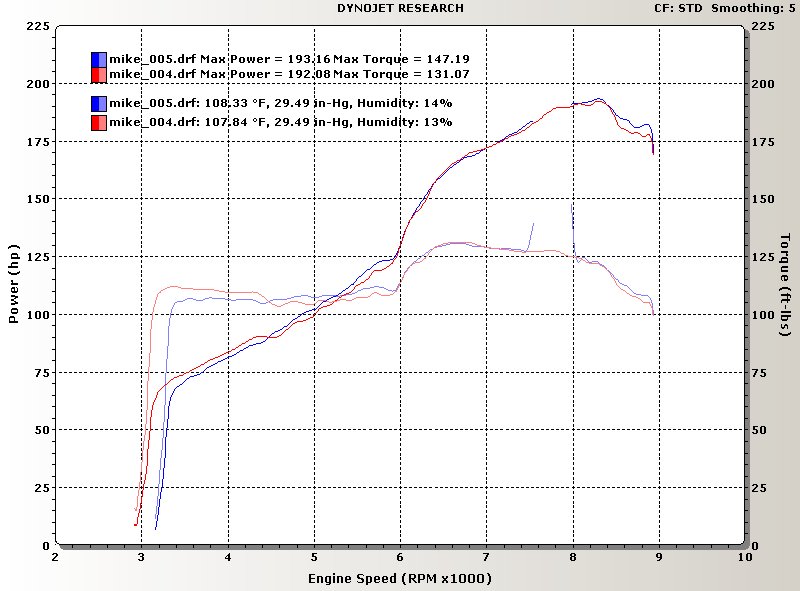
now, im not familiar with the s2k nor did i do the math but looking at the dyno it appears that tq is not really flat- peak is near 6600rpm on the s2k, so that's where peak acceleration is likely to be. if i had to guess, it must be vtec/cam profile switching that caused that jump. this also causes more tq to be generated at 8krpm vs lower rpms ... so you're right, acceleration would be higher up top than down low, gear for gear...so maybe that explains what you feel?
and yes, torque is a rotational force, so i measured it going into the wheel at the axle. i didnt take the final step of including the wheels to the ground as a force (stripping the distance part of T=F*D) so you're right the #s may be off by a certain amount based on the tires fitted..... so yes to be truly correct you'd have to account for 245/40/19s on the G and 255/35/18s on the 335i..
Last edited by tekknikal; Jun 10, 2007 at 08:57 AM.

