


Single Exhaust vs Dual Exhaust


once again...
i and some other members of this and 350z forum have said a million times
in a modern car.... there is no such thing as a need of "backpressure"
to generate low end torque or power..
backpressure only makes us LOSE HP and TQ because work has been done to push through the exhaust gas to the ambient environemt. According to the first law of thermodyanmics, in an adibatic situation, energy from the exhaust flow is extractedfor the work done to push the flow out of the exhaust system..Hence, power and torque is lost because of the energy consumption in pushing through the exhaust gas.
So, why is it the case people often loses low end torque when they go on larger piping? or with a better flowing exhaust? this is because it is very often
for lower rpm range (i.e. slower exhaust flow), the piping is too large that the flow cannot "scavenge" (a pulling effect) effectively.. and hence the flow speed at low rpm and large piping is SLOWER (because by principle of conservation of mass and some basic assumptions... the flow speed is inversley proportional to the cross sectional area of the piping)
Yet, in higher rpm (hence the flow is much faster), the smaller diameter piping actually limits the volumetric flow rate (or better know as Flux) of the flow.. which in turn limits the amount of HP and TQ an engine can produce at high rpm range..
I would really appreciate if the area i live in has a tuner shop that has dyno..so i can provide some more concrete proof on this topic.
Anyways, i do agree on the droning problem in Borla and Stillen because of the resonator and muffler design.
Btw, there are some previous dyno comparsions done in Church automobile awhile ago..and i believe Clint (THX723) was running a true dual exhaust if i am not wrong.
cheers
godmans
i and some other members of this and 350z forum have said a million times
in a modern car.... there is no such thing as a need of "backpressure"
to generate low end torque or power..
backpressure only makes us LOSE HP and TQ because work has been done to push through the exhaust gas to the ambient environemt. According to the first law of thermodyanmics, in an adibatic situation, energy from the exhaust flow is extractedfor the work done to push the flow out of the exhaust system..Hence, power and torque is lost because of the energy consumption in pushing through the exhaust gas.
So, why is it the case people often loses low end torque when they go on larger piping? or with a better flowing exhaust? this is because it is very often
for lower rpm range (i.e. slower exhaust flow), the piping is too large that the flow cannot "scavenge" (a pulling effect) effectively.. and hence the flow speed at low rpm and large piping is SLOWER (because by principle of conservation of mass and some basic assumptions... the flow speed is inversley proportional to the cross sectional area of the piping)
Yet, in higher rpm (hence the flow is much faster), the smaller diameter piping actually limits the volumetric flow rate (or better know as Flux) of the flow.. which in turn limits the amount of HP and TQ an engine can produce at high rpm range..
I would really appreciate if the area i live in has a tuner shop that has dyno..so i can provide some more concrete proof on this topic.
Anyways, i do agree on the droning problem in Borla and Stillen because of the resonator and muffler design.
Btw, there are some previous dyno comparsions done in Church automobile awhile ago..and i believe Clint (THX723) was running a true dual exhaust if i am not wrong.
cheers
godmans
Last edited by godmans; Dec 2, 2005 at 03:48 AM.

Here's one of my favorite sites - learn and check this out...
http://www.nsxprime.com/FAQ/Miscella...austtheory.htm
http://www.nsxprime.com/FAQ/Miscella...austtheory.htm
so that's basically what i have said except that the writer of the thread took into consideration of flow temperature too. Overall, it is a very good writeup tho, and especially on the headers part, where there have been long arguments on
1) long tube
2) short tube
3) equal length or not
for different applications and different rpm range
thanks again for the link,
godmans
1) long tube
2) short tube
3) equal length or not
for different applications and different rpm range
thanks again for the link,
godmans

Clint has a Fuji Y-pipe, so I don't think he is running a true dual.
Also reduce back pressure will cause you to lose low end torque independently of the diameter. Your hypothesis does not explain the effect of decreasing low end torque with the installation of high flow catalytic converters or test pipes.
Also reduce back pressure will cause you to lose low end torque independently of the diameter. Your hypothesis does not explain the effect of decreasing low end torque with the installation of high flow catalytic converters or test pipes.
Originally Posted by godmans
so that's basically what i have said except that the writer of the thread took into consideration of flow temperature too. Overall, it is a very good writeup tho, and especially on the headers part, where there have been long arguments on
1) long tube
2) short tube
3) equal length or not
for different applications and different rpm range
thanks again for the link,
godmans
1) long tube
2) short tube
3) equal length or not
for different applications and different rpm range
thanks again for the link,
godmans
Originally Posted by Sukairain
Clint has a Fuji Y-pipe, so I don't think he is running a true dual.
Also reduce back pressure will cause you to lose low end torque independently of the diameter. Your hypothesis does not explain the effect of decreasing low end torque with the installation of high flow catalytic converters or test pipes.
Also reduce back pressure will cause you to lose low end torque independently of the diameter. Your hypothesis does not explain the effect of decreasing low end torque with the installation of high flow catalytic converters or test pipes.
Originally Posted by Sukairain
Clint has a Fuji Y-pipe, so I don't think he is running a true dual.
Also reduce back pressure will cause you to lose low end torque independently of the diameter. Your hypothesis does not explain the effect of decreasing low end torque with the installation of high flow catalytic converters or test pipes.
Also reduce back pressure will cause you to lose low end torque independently of the diameter. Your hypothesis does not explain the effect of decreasing low end torque with the installation of high flow catalytic converters or test pipes.
Hey Sukairain, thank you correcting me on Clint's setup, since i dun really recall exactly.
With regards to the loss of low end torque that is independent of pipe diameter (i.e. in the case of switching a stock cat to a high flow or test pipe)
in this case, it is still related to the pipe diameter, and let me explain on this:
stock cat is indeed a tube of intensely packed honey comb interior where the restriction to the flow is based on the reduction in "Effective cross sectional area" of the pipe, which is identical to have a smaller diameter downpipe. On the countary, when you use test pipe or high flow cat, you are indeed increasing the effective cross sectional area of the pipe by eliminating part of the honey comb / running a straight through test pipe.
One more thing to consider for the high flow cat is, because you are running a partial proportion of the stock cat (instead of a pre-cat and a real cat in the stock setup), you are decraesing the amount of viscous drag due to the shortening of the honey comb (at a speed of lower than Mach number, viscous drag is dominant when compared to pressure drag), which explains also why running a stock cat will be the same as running smaller diameter piping because you will generally have a lower volumetric flow speed..which flavours the scavenging effect in low flow speed (low rpm) ==> more low end torque ..
Moreover, dun be confused with the muffler business and the cat problems, since they are of two very different design..and functionalities, if you want more, you can take a look at the link posted by ISMSolutions.
Hope this helps to clarify what i have said,
Godmans
FYI this is part of my research area last summer...

Originally Posted by godmans
once again...
i and some other members of this and 350z forum have said a million times
in a modern car.... there is no such thing as a need of "backpressure"
to generate low end torque or power..
backpressure only makes us LOSE HP and TQ because work has been done to push through the exhaust gas to the ambient environemt. According to the first law of thermodyanmics, in an adibatic situation, energy from the exhaust flow is extractedfor the work done to push the flow out of the exhaust system..Hence, power and torque is lost because of the energy consumption in pushing through the exhaust gas.
So, why is it the case people often loses low end torque when they go on larger piping? or with a better flowing exhaust? this is because it is very often
for lower rpm range (i.e. slower exhaust flow), the piping is too large that the flow cannot "scavenge" (a pulling effect) effectively.. and hence the flow speed at low rpm and large piping is SLOWER (because by principle of conservation of mass and some basic assumptions... the flow speed is inversley proportional to the cross sectional area of the piping)
Yet, in higher rpm (hence the flow is much faster), the smaller diameter piping actually limits the volumetric flow rate (or better know as Flux) of the flow.. which in turn limits the amount of HP and TQ an engine can produce at high rpm range..
I would really appreciate if the area i live in has a tuner shop that has dyno..so i can provide some more concrete proof on this topic.
Anyways, i do agree on the droning problem in Borla and Stillen because of the resonator and muffler design.
Btw, there are some previous dyno comparsions done in Church automobile awhile ago..and i believe Clint (THX723) was running a true dual exhaust if i am not wrong.
cheers
godmans
i and some other members of this and 350z forum have said a million times
in a modern car.... there is no such thing as a need of "backpressure"
to generate low end torque or power..
backpressure only makes us LOSE HP and TQ because work has been done to push through the exhaust gas to the ambient environemt. According to the first law of thermodyanmics, in an adibatic situation, energy from the exhaust flow is extractedfor the work done to push the flow out of the exhaust system..Hence, power and torque is lost because of the energy consumption in pushing through the exhaust gas.
So, why is it the case people often loses low end torque when they go on larger piping? or with a better flowing exhaust? this is because it is very often
for lower rpm range (i.e. slower exhaust flow), the piping is too large that the flow cannot "scavenge" (a pulling effect) effectively.. and hence the flow speed at low rpm and large piping is SLOWER (because by principle of conservation of mass and some basic assumptions... the flow speed is inversley proportional to the cross sectional area of the piping)
Yet, in higher rpm (hence the flow is much faster), the smaller diameter piping actually limits the volumetric flow rate (or better know as Flux) of the flow.. which in turn limits the amount of HP and TQ an engine can produce at high rpm range..
I would really appreciate if the area i live in has a tuner shop that has dyno..so i can provide some more concrete proof on this topic.
Anyways, i do agree on the droning problem in Borla and Stillen because of the resonator and muffler design.
Btw, there are some previous dyno comparsions done in Church automobile awhile ago..and i believe Clint (THX723) was running a true dual exhaust if i am not wrong.
cheers
godmans
f
I have the Injen SES on my car without the ressonators... its insanely loud and hard... When i was doing research... With the exception of the possible loss of low end... Total HP/Torque gains were greatest with the Injen exhaust.
f
f
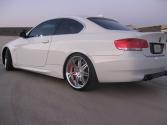
This is my #1 choice for an exhaust. Sounds AMAAZING, best sounding exhaust HANDS DOWN. LOOKS AMAZING...and it weighs ~13 LBS!!
http://www.bulletproofautomotive.com...il.php?ID=3655
buuut its $$pricey$$....
http://www.bulletproofautomotive.com...il.php?ID=3655
buuut its $$pricey$$....



Originally Posted by filipm
I heard that a flux cappacitor(sp?) can solve all your exhaust fluxing issues.
f
f


Thread
Thread Starter
Forum
Replies
Last Post
HeyAsianKid
Intake & Exhaust
3
Oct 7, 2015 01:55 PM
