


My suspension feels weird



Originally Posted by JOKER
so why replace them with same ****?
Because they should have 1/3 the miles you have now. And because it would be a really cheap way to find out wtf is wrong with your car. And if it fixes it, you would be good to go for awhile.
Originally Posted by Jeff92se
Because they should have 1/3 the miles you have now. And because it would be a really cheap way to find out wtf is wrong with your car. And if it fixes it, you would be good to go for awhile.

Registered User
Joined: Aug 2004
Posts: 4,288
Likes: 3
Originally Posted by JOKER
Wouldn't that make car jump more and be more rough on the road?
softer than stock to much stiffer than stock so the only thing that would
force your car to jump is if your springs are stiff.... meaning over 550lbs/in.
just adjust damping to match your spring rates and should be pretty smooth.
Originally Posted by kenchan
jump more... not sure wat you mean, but the D-Spec is adjustable from
softer than stock to much stiffer than stock so the only thing that would
force your car to jump is if your springs are stiff.... meaning over 550lbs/in.
just adjust damping to match your spring rates and should be pretty smooth.
softer than stock to much stiffer than stock so the only thing that would
force your car to jump is if your springs are stiff.... meaning over 550lbs/in.
just adjust damping to match your spring rates and should be pretty smooth.
When car hits the bump and spring compresses car stays in one place cuz spring is compressed.
If the spring is not compressed then the hole freaking car jumps up.
Actually if the shocks are that stiff, the suspension would tend to stay compressed and the would just "thunk" down. IMHO, you would have to have those D specs on full hard on to get them to do that.
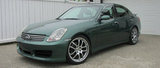

Almost sounds like 'bump steer' like they used to get on old solid-front-axle hot rods. When you hit a bump, it actually slightly changes the direction of your tire (I think someone suggested something like this due to rear toe). But if Tito's feeling it on a stock car, that doesn't make sense.
Joker, was it happening before you put the bald rear tire on?
Joker, was it happening before you put the bald rear tire on?

Bumpsteer is when the lower control arm becomes parallel or worse when the suspension compresses. Yes, something that lowered cars have. Not sure if Joker's springs are actually that low.
Originally Posted by SwivelMan
Almost sounds like 'bump steer' like they used to get on old solid-front-axle hot rods. When you hit a bump, it actually slightly changes the direction of your tire (I think someone suggested something like this due to rear toe). But if Tito's feeling it on a stock car, that doesn't make sense.
Joker, was it happening before you put the bald rear tire on?
Joker, was it happening before you put the bald rear tire on?
Maybe it's me just getting use to aftermarket springs and all that
Originally Posted by Jeff92se
Bumpsteer is when the lower control arm becomes parallel or worse when the suspension compresses. Yes, something that lowered cars have. Not sure if Joker's springs are actually that low.
http://www.panteraplace.com/page135.htm
Ugh, it might be the fact that the steering rod gets too long then too short as the supension compresses. As the rod gets parallel, it effectively gets longer, thus artically steering the car.
OEM suspensions are designed so that the control arm and tie rods are almost always NOT parallel. But when you lower the car all bets are off.
On old school 510s, you could order bump steer spacer that went inbtween the lower control arm and strut to restore the oem control arm/ tie rod angles.
Ugh, it might be the fact that the steering rod gets too long then too short as the supension compresses. As the rod gets parallel, it effectively gets longer, thus artically steering the car.
OEM suspensions are designed so that the control arm and tie rods are almost always NOT parallel. But when you lower the car all bets are off.
On old school 510s, you could order bump steer spacer that went inbtween the lower control arm and strut to restore the oem control arm/ tie rod angles.