


BBK Myths


Thanks for that. But it said that doubling speed will quadruple brake temperature, meaning that a 120-0 stop will generate 4 times the heat as 60-0 stop. It doesnt say anything about 120-60. Deceleration rate is not constant so it is actually pretty difficult to determine the work done from a 120-60 braking event. I really don't feel like doing to the math to show what the difference in heat generation would actually be. Also it doesn't account for the higher heat transfer to the air due to higher velocity.
Without doing the math, I cannot accurately say how much more heat would be generated. But main point of this thread is still that larger brakes do not improve stopping distance and OEM brakes are more than capable of handling the demand of a street driven G35. BBKs on a G35 is purely a cosmetic modification.
Without doing the math, I cannot accurately say how much more heat would be generated. But main point of this thread is still that larger brakes do not improve stopping distance and OEM brakes are more than capable of handling the demand of a street driven G35. BBKs on a G35 is purely a cosmetic modification.
Originally Posted by StopTech
It follows then that the temperature rise of the braking system is directly proportional to
the mass of the vehicle in motion. More importantly perhaps, the temperature rise of the
braking system is directly proportional to the square of the velocity of the vehicle in
motion. In other words, doubling speed will theoretically quadruple brake temperatures:
In practical application, tire rolling resistance, aerodynamic drag, grade resistance, and
other mechanical losses will also play an energy-absorbing role, but value is still placed
in establishing this fundamental relationship as a limiting condition.
the mass of the vehicle in motion. More importantly perhaps, the temperature rise of the
braking system is directly proportional to the square of the velocity of the vehicle in
motion. In other words, doubling speed will theoretically quadruple brake temperatures:
In practical application, tire rolling resistance, aerodynamic drag, grade resistance, and
other mechanical losses will also play an energy-absorbing role, but value is still placed
in establishing this fundamental relationship as a limiting condition.

Registered User
Joined: Jul 2005
Posts: 415
Likes: 58
Thanks for that. But it said that doubling speed will quadruple brake temperature, meaning that a 120-0 stop will generate 4 times the heat as 60-0 stop. It doesnt say anything about 120-60. Deceleration rate is not constant so it is actually pretty difficult to determine the work done from a 120-60 braking event. I really don't feel like doing to the math to show what the difference in heat generation would actually be. Also it doesn't account for the higher heat transfer to the air due to higher velocity.
Without doing the math, I cannot accurately say how much more heat would be generated. But main point of this thread is still that larger brakes do not improve stopping distance and OEM brakes are more than capable of handling the demand of a street driven G35. BBKs on a G35 is purely a cosmetic modification.
Without doing the math, I cannot accurately say how much more heat would be generated. But main point of this thread is still that larger brakes do not improve stopping distance and OEM brakes are more than capable of handling the demand of a street driven G35. BBKs on a G35 is purely a cosmetic modification.
So From 120-0 is 4x energy, and 60-0 is 1x energy, so obviously 120-60 is 3x energy.
This topic has been derailed. It was assumed everyone here had street driven G35s. Yes if you own a supercar or a dedicated track car, then this topic doesn't really apply to you. Point was, if you own a street driven G35, a BBK will provide no performance value.
If you want to improve your stopping distance, get better tires.
If you want to reduce brake fade, get better pads.
If you want to prevent vapor lock, get better brake fluid and lines.
If you want to improve visual appearance of your car, get a BBK.
If you want to improve your stopping distance, get better tires.
If you want to reduce brake fade, get better pads.
If you want to prevent vapor lock, get better brake fluid and lines.
If you want to improve visual appearance of your car, get a BBK.
but at the track(autox doesn't count), bigger rotors do dissipate more heat, and have less fade, which is sorely appreciated for our heavy cars.

Joined: Oct 2005
Posts: 14,494
Likes: 996
From: Neverland
Ignoring air resistance and rolling resistance, it's pretty easy to calculate, work done is just energy initial - energy final. It is especially easy because the numbers chosen are super duper convenient. K=MV^2, so double the speed, obviously quadruple the energy.
So From 120-0 is 4x energy, and 60-0 is 1x energy, so obviously 120-60 is 3x energy.
Agree for street driven g35.
but at the track(autox doesn't count), bigger rotors do dissipate more heat, and have less fade, which is sorely appreciated for our heavy cars.
So From 120-0 is 4x energy, and 60-0 is 1x energy, so obviously 120-60 is 3x energy.
Agree for street driven g35.
but at the track(autox doesn't count), bigger rotors do dissipate more heat, and have less fade, which is sorely appreciated for our heavy cars.
Almost no one on this forum tracks their G35 in any competitive form, the handful that due are exempt from this topic. Rotor size has almost nothing to do with brake fade. Brake fade is a function of pad material.
Registered User
Joined: Jul 2005
Posts: 415
Likes: 58
People please read prior to commenting. Deceleration is not a constant linear rate. Mass is not a constant rate either as it shifts during breaking. The time to brake or distance from 120-60 is not known either. Also kinetic energy is not a measure of work done. So no, 120-60 is not simply 3x the energy. Not a single thing you said was even remotely correct.
Almost no one on this forum tracks their G35 in any competitive form, the handful that due are exempt from this topic. Rotor size has almost nothing to do with brake fade. Brake fade is a function of pad material.
Almost no one on this forum tracks their G35 in any competitive form, the handful that due are exempt from this topic. Rotor size has almost nothing to do with brake fade. Brake fade is a function of pad material.
hahaha "mass is not a constant" really tickles my fancy.

I guess technically it is accurate, as you may shed like 2 grams of brake dust while braking. So I guess if you are aiming for like 8 sig figs you would have to factor that in your model. I think what you mean to say is that the normal force on each wheel is not constant, which is true, but is really of not that much interest in this instance, since once you hit the tire limits, the weight shift stays fairly constant.
haha, "LISA, IN THIS HOUSE, WE OBEY THE LAWS OF THERMODYNAMICS"
A change in kinetic energy is a measure of work done (which is path independent!). So unless you are storing the energy in the form of chemical (hybrid car), or other form of kinetic energy (F1 KERS), the kinetic energy from the movement of the car and the rotation of the wheels has to be dealt with somehow, mostly in the form of heat (conservation of energy). Of course, not all of it goes to the rotors. The tires gain some heat, there is some lost to heat along the body with air resistance, heat to the engine from engine braking, heat shed through the transmission and all the various differentials and gears and bearings, but the VAST majority gets turned into heat at the brake pad/rotor interface, and of that, like 80% goes to the rotor. How else do you think brake systems work?
----> http://www.engineeringinspiration.co.uk/brakecalcs.html
You don't have to track "competitively" to get angry at brake fade. In fact, I would say people who track competitively have less of an issue than HPDE folk. If you track competitively, you run race pads that work at like a billion degrees, and heat dissipation is a function of difference in temperature from the 2 media, so you can dissipate the energy faster if you run your rotors hotter. But you can't run race pads on the street, and because of the bedding issue, swapping brake pads and swapping rotors is a pain in the ***. So I run hybrid street/track pads (have tried hawk hp+ and stoptech street performance), which still always keep un-bedding on the street and still fading at the track.
But yes, you would have to be doing something seriously illegal and trying really hard to fade good street pads on the street (like bedding them in).
edit: Bonus reading
Bigger rotors dissipate more heat.
http://en.wikipedia.org/wiki/Convective_heat_transferdQ/dt ∝ Area
edit 2: I've spent way too much time on this.
can't find a great article on modeling and measuring heat dissipation from rotors and diameter. probable because it's kind of a semi-retarded question to be asking in a journal. Also, most of the papers are behind a pay-wall.
here is a kind of crappy article that doesn't take into account like anything (flow through vanes, conductive heat transfer) http://www.fem.unicamp.br/~phoenics/...referencia.pdf
Here are some semi interesting papers if you have access:
http://www.sciencedirect.com/science...90072907000853
http://pid.sagepub.com/content/217/8/657.short
anyone have SAE access want to pull these articles?
http://papers.sae.org/780352/
http://papers.sae.org/2005-01-3943/
http://papers.sae.org/751014/
edit 3: why am i still here?
http://www.scribd.com/doc/30859455/Vented-Brake-Rotor
formulas 1 and 2 rate of convection ∝ area
Last edited by totopo; Aug 27, 2013 at 01:32 AM.
Joined: Oct 2005
Posts: 14,494
Likes: 996
From: Neverland
Joined: Oct 2005
Posts: 14,494
Likes: 996
From: Neverland
Agreed and it was not discussed. But you are correct that a BBK will change the pedal feel and provide the pseudo effect that the car has more stopping power. The increased confidence often causes drivers to push the car harder believing their braking has improved.


Actually brake feel is the ability to better determine the braking force and to be able to modulate the brake force. It doesn't give the driver any false sense of the braking system's capacity
Agreed and it was not discussed. But you are correct that a BBK will change the pedal feel and provide the pseudo effect that the car has more stopping power. The increased confidence often causes drivers to push the car harder believing their braking has improved.
Registered User
Joined: Jul 2005
Posts: 415
Likes: 58
sorry in advance, on phone now, but i can add pretty charts and references later if you care to give an actual reply.
so i didn't mention it because i thought it was too obvious, but you do realize the coefficient of friction between brake pad and rotor is dependent on and changes with temperature right? so usually brake pad fade is due to the coefficient of friction dropping off at high temperatures. race brakes and sport pads work at higher temps than cheap pads, but they still do drop off at high temperatures. so when you brake, the rotors heat up, then when you are not braking, the system dissipate heat through convection to air through rotors and calipers, and through conduction to the axle and radiation in ir. so through repetitive braking, you build up heat and the system eventually ends up at an equilibrium on the track where the heat dissipated during corners and straights equal the heat buildup during braking. so the ways to reduce fade, are to get friction materials that run at higher t, and at improving the rate of cooling to get the equilibrium temp down. bigger rotors dissipate more heat, so your track temps are lower. bigger calipers also dissipate more heat, not as big of a deal as the rotors, but they do help.
in the case of one time braking, cooling becomes less of an issue because the input of heat far outstrips the dissipation that the effects are kind of minimal. but heat capacitance on the other hand has a huge impact on the system temp, and bigger rotors have a bigger heat capacitance
Joined: Oct 2005
Posts: 14,494
Likes: 996
From: Neverland
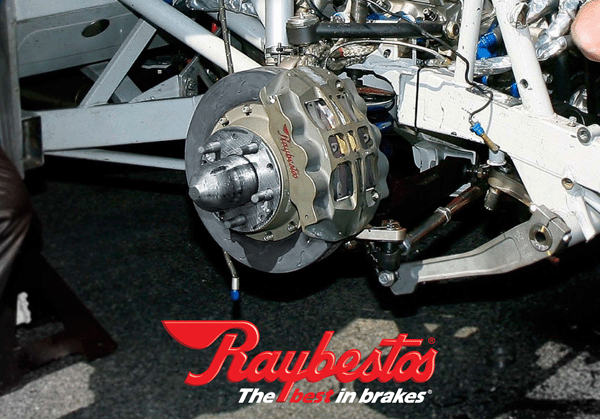
Picture of a NASCAR brake system. Not street driving of course. But a relatively heavy car running very high speeds requires a brake system of a certain power, feel and thermal capacity
Now with THAT, I'll tell you this. I upgraded from the small 2003 brakes to the larger 2005 brakes. Both are still floating and not considered a BBK. But the 2005 brakes feature twin piston front calipers and larger rotors. Rears use the same calipers but with larger rotors. The increased brake force from the larger rotors allows the 2005 brakes to match the 2003 brake 60-0 performance WITHOUT having to use such aggressive pad compounds.
Now with THAT, I'll tell you this. I upgraded from the small 2003 brakes to the larger 2005 brakes. Both are still floating and not considered a BBK. But the 2005 brakes feature twin piston front calipers and larger rotors. Rears use the same calipers but with larger rotors. The increased brake force from the larger rotors allows the 2005 brakes to match the 2003 brake 60-0 performance WITHOUT having to use such aggressive pad compounds.
Joined: Oct 2005
Posts: 14,494
Likes: 996
From: Neverland

op is an idiot. seems like he is butthurt because he cannot buy a BBK so he is bashing all the "stock" G35 for having them.
put 2" rotors on your G35 and go down the nearest mountain rd and tell me fade only happens in the pads.
Heat builds up in the pads because the heat into the brake system is greater than the heat being dissipated by the brake system. Larger rotors with internal vanes dissipate heat better.
Keep spewing your garbage and making up the rules as you go along to validate your original post.
Totopo...were wasting our time here.
put 2" rotors on your G35 and go down the nearest mountain rd and tell me fade only happens in the pads.
Heat builds up in the pads because the heat into the brake system is greater than the heat being dissipated by the brake system. Larger rotors with internal vanes dissipate heat better.
Keep spewing your garbage and making up the rules as you go along to validate your original post.
Totopo...were wasting our time here.