


Boost and altitude?


Thread Starter
|
Devil's Advocate
Joined: Apr 2004
Posts: 3,404
Likes: 0
From: Vegas
Boost and altitude?
I was arguing this with a friend last night, maybe you can tell us who's right.
Example, Say I'm running 8 pounds of boost at sea level then I travel to Denver. If I change nothing on the car, will I still make 8 pounds of boost in Denver?
If yes, will the 8 pounds of boost in both places have the same air density (assuming that the temps, humidity etc. are the same)?
If no, why the hell not?
Example, Say I'm running 8 pounds of boost at sea level then I travel to Denver. If I change nothing on the car, will I still make 8 pounds of boost in Denver?
If yes, will the 8 pounds of boost in both places have the same air density (assuming that the temps, humidity etc. are the same)?
If no, why the hell not?

No you wont. Even thought the altitude doesnt hurt boosted cars as much it still does some. I did a stage 2 stillen here and the car was only seeing 5psi. The coupe I've been building with a vortech set up is also only seeing 5 maybe 5.5 pounds. We think it may have a boost leak by the MAF. But we're having a new piece made to solve that problem  . It's still the same basic principal, less air is less air.
. It's still the same basic principal, less air is less air.

I'd say it will make 8lbs of boost, IF we're assuming that the limiting factor is the wastegate. 8lbs of boost is relative to atmospheric pressure. If the difference in atmospheric pressure between sea and Denver is 1lb, then the boosted pressure (manifold) will be 1lb less overall but will still show 8lbs because of the difference in the base (atmospheric) pressure.
So it'll still show 8lbs but absolute manifold pressure will be less in denver when compared to sea.
So it'll still show 8lbs but absolute manifold pressure will be less in denver when compared to sea.

Registered User
Joined: Oct 2006
Posts: 44
Likes: 0
From: Las Vegas
Here is a good example of what will happen,
Warrtalon a fello evo owner lived in MA and was running 12.0 consistantly. He then moved to Colorado Spring and had trouble clicking off 12.4's and had to shift one more gear. Just like Bad said the Boost level will remain the same but the density of the air will change reducing the overall volume being shoved into your motor.
Warrtalon a fello evo owner lived in MA and was running 12.0 consistantly. He then moved to Colorado Spring and had trouble clicking off 12.4's and had to shift one more gear. Just like Bad said the Boost level will remain the same but the density of the air will change reducing the overall volume being shoved into your motor.


On turbo systems with a EBC your boost will not change, but on superchargers when boost is mechanicaly limited by RPM it will change.
Trending Topics

Registered User
Joined: Jun 2006
Posts: 253
Likes: 0
From: San Diego
We built a car here in San Diego and the car made 385 WHP on the DYNOJET. The customer went to Santa Fe NM and the car only made 335 on a Dynojet with the same correction.
AT 8 PSI.
The oxygen levels due to altitude must change things about 10-15%.
M

AT 8 PSI.
The oxygen levels due to altitude must change things about 10-15%.
M

C'mon guys, I'm an art school dropout and even I understand the concept.
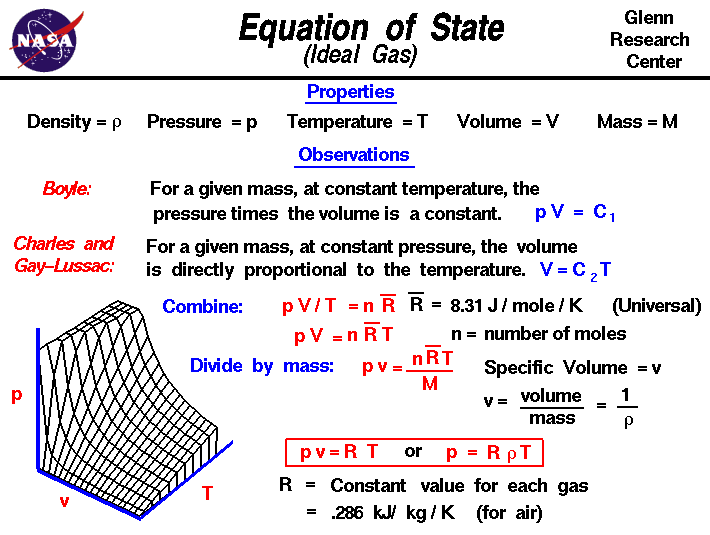
So what this means is that assuming a constant temperature
Pressure / Density = R * Temperature
Since R is a constant, and we're holding temperature as a constant, that means pressure and density are propotional to each other. If density decreases, pressure has to decrease by the same rate.
Air is less dense at higher altitudes. Its a known fact. This means that your pressure goes down as well for the same temperature. At sea level, atmospheric pressure should be 14.7 psi. That means when you're generating 8 psi of boost, you're actually pushing 22.7 psi of air into the combustion chamber. But at higher altitudes your atmospheric pressure is going to drop.
For example, if you're at the CA coast with 14.7 psi atmospheric pressure generating 8 psi of peak boost then go to Denver and atmospheric is 12.9 psi. On a supercharger, you're only going to generate 7 psi of boost because its a fixed rate based off the crank speed. You can still generate 8 psi with a turbocharger, but the turbo's will have to work harder. So if you're close to your maximum efficiency generating 8 psi because you have smaller turbos, odds are you'll not hit 8 psi If you have larger turbos that can generate 8 psi efficienty at sea level, they'll still have enough capacity to push 8 psi at higher altitude. You might have some lag and the boost will peak later because it'll take more exhaust gasses to push the turbos harder, but you can do it.
So yes, your 8 psi, will have the same density. But instead of pushing 22.7 psi into the cylinder, you'll only be pushing 20.9 psi. Your overall pressure is lower, because what your boost gauge reads as 8 psi, is 8 psi over atmospheric pressure. Not an absolute 8 psi. Absolute pressure is atmospheric + boost.
Ultimately, the less dense air means a greater volume of air has to be compressed to make the same pressure. Turbochargers can compensate for it, but it doesn't mean they will.
So what this means is that assuming a constant temperature
Pressure / Density = R * Temperature
Since R is a constant, and we're holding temperature as a constant, that means pressure and density are propotional to each other. If density decreases, pressure has to decrease by the same rate.
Air is less dense at higher altitudes. Its a known fact. This means that your pressure goes down as well for the same temperature. At sea level, atmospheric pressure should be 14.7 psi. That means when you're generating 8 psi of boost, you're actually pushing 22.7 psi of air into the combustion chamber. But at higher altitudes your atmospheric pressure is going to drop.
For example, if you're at the CA coast with 14.7 psi atmospheric pressure generating 8 psi of peak boost then go to Denver and atmospheric is 12.9 psi. On a supercharger, you're only going to generate 7 psi of boost because its a fixed rate based off the crank speed. You can still generate 8 psi with a turbocharger, but the turbo's will have to work harder. So if you're close to your maximum efficiency generating 8 psi because you have smaller turbos, odds are you'll not hit 8 psi If you have larger turbos that can generate 8 psi efficienty at sea level, they'll still have enough capacity to push 8 psi at higher altitude. You might have some lag and the boost will peak later because it'll take more exhaust gasses to push the turbos harder, but you can do it.
So yes, your 8 psi, will have the same density. But instead of pushing 22.7 psi into the cylinder, you'll only be pushing 20.9 psi. Your overall pressure is lower, because what your boost gauge reads as 8 psi, is 8 psi over atmospheric pressure. Not an absolute 8 psi. Absolute pressure is atmospheric + boost.
Ultimately, the less dense air means a greater volume of air has to be compressed to make the same pressure. Turbochargers can compensate for it, but it doesn't mean they will.
Thread Starter
|
Devil's Advocate
Joined: Apr 2004
Posts: 3,404
Likes: 0
From: Vegas
I made a similar argument at my350Z where I also posted the question. Someone told me I was wrong, someone told me I was right, and Gurgen wrote a novel that I am still trying to digest.
http://www.my350z.com/forum/showthread.php?t=222940
http://www.my350z.com/forum/showthread.php?t=222940

Registered User
Joined: Oct 2005
Posts: 2,381
Likes: 0
From: NY
Originally Posted by roneski
I made a similar argument at my350Z where I also posted the question. Someone told me I was wrong, someone told me I was right, and Gurgen wrote a novel that I am still trying to digest.
http://www.my350z.com/forum/showthread.php?t=222940
http://www.my350z.com/forum/showthread.php?t=222940


I wish there is simpler way to get the answer

^^^LOL...... funny as hell. Well, I just wanted to help. Beats MrA's customer's 335/385 hp comparison substantiates what i was saying in the other thread. With the kind of EM that VRT uses, that has no altitude compensation, and i bet you (i am guessing though) no proper IAT compensation implemented, my estimated of 18-20% power loss were right on. I bet you that he would dyno at 315-320 if the temperature up ther was the same as in SD, that chances are about 95% that it was lower..hence his lack of alt compensation was a little corrected by the lack of IAT compensation.
Registered User
Joined: Jun 2006
Posts: 253
Likes: 0
From: San Diego
Originally Posted by GurgenPB
^^^LOL...... funny as hell. Well, I just wanted to help. Beats MrA's customer's 335/385 hp comparison substantiates what i was saying in the other thread. With the kind of EM that VRT uses, that has no altitude compensation, and i bet you (i am guessing though) no proper IAT compensation implemented, my estimated of 18-20% power loss were right on. I bet you that he would dyno at 315-320 if the temperature up ther was the same as in SD, that chances are about 95% that it was lower..hence his lack of alt compensation was a little corrected by the lack of IAT compensation.
M

Thread
Thread Starter
Forum
Replies
Last Post

