


How often should a car be Clayed?


Registered User
Joined: May 2008
Posts: 167
Likes: 0
I clay my car before every detailing, so about four times a year. Regular detailing and washing will let you get away with minimum claying. Just clay until there is no resistence. I rarely need more than one or two passes over a panel and there is minimal grime. Invest in one of the larger clay bars and cut it into multiple pieces you can keep in a stay fresh bag. It will last longer than the store bought sized bars and be cheaper in the long run.
Clay Bar
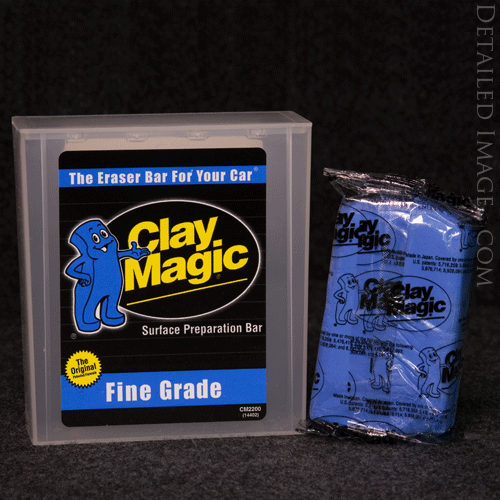
You can use a lube and clay after you wash or use a car wash with excellent lubrication and clay as you wash your car a second time. I prefer the first method followed by a quick rinse. Remember claying will remove whatever wax you do have on the car, so if you clay, you should at least follow up with a wax if not a light polish and wax.
Clay Bar
You can use a lube and clay after you wash or use a car wash with excellent lubrication and clay as you wash your car a second time. I prefer the first method followed by a quick rinse. Remember claying will remove whatever wax you do have on the car, so if you clay, you should at least follow up with a wax if not a light polish and wax.
Last edited by blueboxer; May 19, 2008 at 10:09 PM.





Registered User
Joined: Mar 2008
Posts: 128
Likes: 0
i clay the whole car about 2 times a year. and the front bumper, hood, roof, and trunk lid 4 times a year. but there is no definite answer because every environment is different. if your car is exposed to a harsh environment then you will probably want to wash wax and clay more often than a car that is garage 24/7 and never driving. i would say at least 1 time a year. you can do it more often if you choose as the clay is nonabbrasive as is the lubricant so you arent removing any clear.

Registered User
Joined: Jul 2007
Posts: 170
Likes: 4
From: London, UK / Ponte Vedra Beach, FL
"you can do it more often if you choose as the clay is nonabbrasive as is the lubricant so you arent removing any clear".
as the clay is non abrasive-
Automotive clay is not a replacement for polish or a compound; it is a pliable, petroleum resin product, Polybutene PB-1 (Polyisobutylene) containing a mild abrasive(s) i.e. kaolin, silica sand, calcium carbonate, alumina, ceramics quartz and also silicon carbide that polishes and exfoliates bonded surface contaminants by shearing ( a popular misconception - it does not pull or extract contaminants from a paint surface, if this was the case there would be no need for it to be abrasive) it is then encapsulated by the clay resin. These abrasives are extremely small with an average particle size of 1- µ (micron) dependant on the aggressiveness required, mixed in with a powdered synthetic detergent.
Using a clay bar will not remove clear coat but it will remove a % of wax / sealant
as the clay is non abrasive-
Automotive clay is not a replacement for polish or a compound; it is a pliable, petroleum resin product, Polybutene PB-1 (Polyisobutylene) containing a mild abrasive(s) i.e. kaolin, silica sand, calcium carbonate, alumina, ceramics quartz and also silicon carbide that polishes and exfoliates bonded surface contaminants by shearing ( a popular misconception - it does not pull or extract contaminants from a paint surface, if this was the case there would be no need for it to be abrasive) it is then encapsulated by the clay resin. These abrasives are extremely small with an average particle size of 1- µ (micron) dependant on the aggressiveness required, mixed in with a powdered synthetic detergent.
Using a clay bar will not remove clear coat but it will remove a % of wax / sealant
Trending Topics
Registered User
Joined: Jul 2007
Posts: 170
Likes: 4
From: London, UK / Ponte Vedra Beach, FL
a) Does my paint surface require the application of detailer’s clay?
Is the paint surface showing one or more of the following; coloured or yellow stains, water marks (spots) black metallic coloured flecks, a rough texture, etch marks (concave depression) oxidation, bug or bird excrement, place some saran wrap or a zip lock bag over your hand (‘bag test’) and rub across the finish lightly. Every snag you feel is a surface contaminant that the clay bar can remove but you may not be able to see, especially on white or light coloured vehicle surfaces.
b) How often should I use detailer’s clay?
That would depend upon your environment and how you maintain your car see ‘bag test’ above. If you find the need to use detailer’s clay on a regular basis use mild clay
See also 'Detailers Clay' DetailingWiki
Is the paint surface showing one or more of the following; coloured or yellow stains, water marks (spots) black metallic coloured flecks, a rough texture, etch marks (concave depression) oxidation, bug or bird excrement, place some saran wrap or a zip lock bag over your hand (‘bag test’) and rub across the finish lightly. Every snag you feel is a surface contaminant that the clay bar can remove but you may not be able to see, especially on white or light coloured vehicle surfaces.
b) How often should I use detailer’s clay?
That would depend upon your environment and how you maintain your car see ‘bag test’ above. If you find the need to use detailer’s clay on a regular basis use mild clay
See also 'Detailers Clay' DetailingWiki

I clay as needed or before a polishing session. It usually ends up being 2 ~ 3 times per year. Using a milder clay bar will be less likely to add swirls or micro-marring, where a medium grade or heavy duty clay will often leave marring behind that needs to be polished out. If you maintain your car on a regular basis, always stick with the fine grade bars. If you have paint overspray (or something similar) then using a medium grade bar can increase the speed of removal, but plan on polishing afterwards.
George
George

Thread
Thread Starter
Forum
Replies
Last Post
Tolboothwilley™
Exterior-Vendor
6
Jul 28, 2016 12:42 AM
marsman328
Northern California
1
Aug 11, 2015 07:29 PM


