


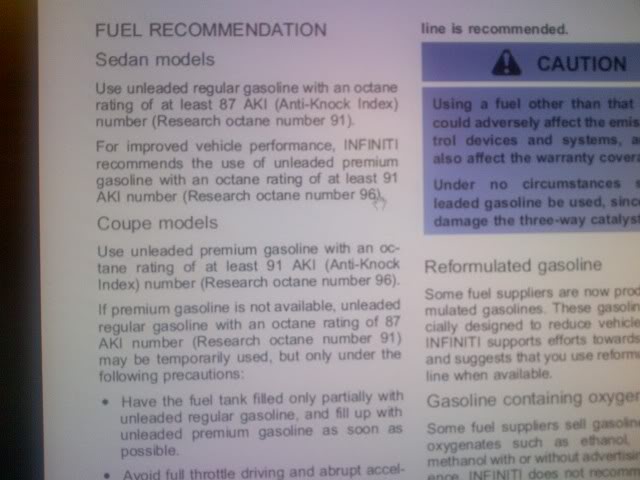
Ok to use 87 octane gas on an 04 g35 sedan AT?


Super Moderator


Joined: Mar 2011
Posts: 2,605
Likes: 197
From: Central NJ
Front and rear cameras, tire pressure for all four tires can display on screen,folding side view mir

Registered User
Joined: Mar 2011
Posts: 436
Likes: 61
From: Phoenix, AZ
Super Moderator
Joined: Mar 2011
Posts: 2,605
Likes: 197
From: Central NJ
Front and rear cameras, tire pressure for all four tires can display on screen,folding side view mir

So far on my G37 I've used 1045 gallons @ $.36/gallon savings using regular I've saved $376.00
On my 06 G35 over 171796 miles I used 7170 gallons of regular. X $.30 /gallon savings, I' saved $2581.00. Total the two vehicle savings by using regular I've saved almost three thousand dollars.
Better in my pocket than the oil companies

Telcoman



It's exactly the same as the 05. For what it's worth I've run 87 in my car before and after getting it tuned, before the tune, you couldn't tell it was 87, after it pings if you get on it in the standard performance map. I think the difference between the coupe and sedan is the map.

You won't see a huge difference in performance between anything above 91 on stock motors and daily driving. Out here in CA, we have 87, 89 and 91. Some gas stations have 100 as well. But once you start modding and tuning, there will be a difference in overall power output.
Last edited by dofu; Oct 3, 2013 at 05:52 PM.
For example:
Cars can run well on lower octane at high elevation. You tend to find 85 octane in the mountains, and 93 octane near sea level. This is related to the density of the air at lower elevations.
Cars also tend to detonate in higher temps, than lower temps.
They also detonate more in dry air, vs humid air. I know from my drag racing experience in my mustang (hundreds of passes for several years when I used to compete in amateur events) that in the fall when humidity dropped, I would back my timing down to prevent detonation. It would always been in the fall when the humidity dropped like a rock. Car would ping like crazy and I'd either up the octane level, or drop the timing down.
Also, octane requirements tend to rise as the vehicle ages. Carbon deposits in the combustion chamber can raise compression ratio as well as cause the fuel to pre ignite.
So just those 4 things alone make a difference considering the varied terrain and climate in this country that engineers had to adapt to. So for example, a brand new car running 87 octane, at higher elevation where it's cooler with average humidity, may run beautifully. Now that same model car, but with 150k miles in Death Valley where is below sea level, hot as hell and dry with little humidity, may detonate like crazy on the same octane. Same factory tune, just different circumstances.
So it's hard to issue a blanket statement as to which octane to run. There are many, many factor to consider. What works for one person, won't work for another. There are a lot of "behind the scenes" factors that some guys never think about.
Another thing....knock sensors can fail. Typically you really don't want to rely on them to save your car because if they fail, you can damage your head and pistons. That can get very, very expensive.
For some....higher octane can be a form of insurance. For others, it is a waste of cash.
In all the forums I'm a member of....the octane threads tend to be the most passionate.
I own 3 cars....and actually run different octanes in all 3 for different reasons.
Last edited by Mustang5L5; Oct 3, 2013 at 09:53 PM.
Super Moderator
Joined: Mar 2011
Posts: 2,605
Likes: 197
From: Central NJ
Front and rear cameras, tire pressure for all four tires can display on screen,folding side view mir
If anything it might be the difference between sport and non-sport models: the sport models might have a bit more advanced timing from the factory, meaning you will need the higher octane. The difference is still not between sedan or coupe.
You won't see a huge difference in performance between anything above 91 on stock motors and daily driving. Out here in CA, we have 87, 89 and 91. Some gas stations have 100 as well. But once you start modding and tuning, there will be a difference in overall power output.
You won't see a huge difference in performance between anything above 91 on stock motors and daily driving. Out here in CA, we have 87, 89 and 91. Some gas stations have 100 as well. But once you start modding and tuning, there will be a difference in overall power output.


Telco man thanks for the very factual data. Could you throw up your unique data like elevation and mpg average for each of the three octanes? Or is it you only tried premium for a month?
Thanks!
Thanks!
Super Moderator
Joined: Mar 2011
Posts: 2,605
Likes: 197
From: Central NJ
Front and rear cameras, tire pressure for all four tires can display on screen,folding side view mir
BTW I can't speak for all dealers but my two new Infiniti's came delivered with a full tank of regular.gasoline.
Does anyone really believe dealers are going to spend the extra money to deliver a new vehicle with a full tank of premium
My test hill
The elevation rises from 52ft above sea level at the bottom of the hill to 175 ft above sea level at the top a distance of over 1/2 mile.

Test results on my06 G35

Last edited by telcoman; Oct 4, 2013 at 07:25 AM.
Super Moderator
Joined: Mar 2011
Posts: 2,605
Likes: 197
From: Central NJ
Front and rear cameras, tire pressure for all four tires can display on screen,folding side view mir
The factory tends to leave a lot off the table for safety sake as well as trying to adapt a car to run in the many various environmental conditions a car driven in this country will see.
For example:
Cars can run well on lower octane at high elevation. You tend to find 85 octane in the mountains, and 93 octane near sea level. This is related to the density of the air at lower elevations.
Cars also tend to detonate in higher temps, than lower temps.
They also detonate more in dry air, vs humid air. I know from my drag racing experience in my mustang (hundreds of passes for several years when I used to compete in amateur events) that in the fall when humidity dropped, I would back my timing down to prevent detonation. It would always been in the fall when the humidity dropped like a rock. Car would ping like crazy and I'd either up the octane level, or drop the timing down.
Also, octane requirements tend to rise as the vehicle ages. Carbon deposits in the combustion chamber can raise compression ratio as well as cause the fuel to pre ignite.
So just those 4 things alone make a difference considering the varied terrain and climate in this country that engineers had to adapt to. So for example, a brand new car running 87 octane, at higher elevation where it's cooler with average humidity, may run beautifully. Now that same model car, but with 150k miles in Death Valley where is below sea level, hot as hell and dry with little humidity, may detonate like crazy on the same octane. Same factory tune, just different circumstances.
So it's hard to issue a blanket statement as to which octane to run. There are many, many factor to consider. What works for one person, won't work for another. There are a lot of "behind the scenes" factors that some guys never think about.
Another thing....knock sensors can fail. Typically you really don't want to rely on them to save your car because if they fail, you can damage your head and pistons. That can get very, very expensive.
For some....higher octane can be a form of insurance. For others, it is a waste of cash.
In all the forums I'm a member of....the octane threads tend to be the most passionate.
I own 3 cars....and actually run different octanes in all 3 for different reasons.
For example:
Cars can run well on lower octane at high elevation. You tend to find 85 octane in the mountains, and 93 octane near sea level. This is related to the density of the air at lower elevations.
Cars also tend to detonate in higher temps, than lower temps.
They also detonate more in dry air, vs humid air. I know from my drag racing experience in my mustang (hundreds of passes for several years when I used to compete in amateur events) that in the fall when humidity dropped, I would back my timing down to prevent detonation. It would always been in the fall when the humidity dropped like a rock. Car would ping like crazy and I'd either up the octane level, or drop the timing down.
Also, octane requirements tend to rise as the vehicle ages. Carbon deposits in the combustion chamber can raise compression ratio as well as cause the fuel to pre ignite.
So just those 4 things alone make a difference considering the varied terrain and climate in this country that engineers had to adapt to. So for example, a brand new car running 87 octane, at higher elevation where it's cooler with average humidity, may run beautifully. Now that same model car, but with 150k miles in Death Valley where is below sea level, hot as hell and dry with little humidity, may detonate like crazy on the same octane. Same factory tune, just different circumstances.
So it's hard to issue a blanket statement as to which octane to run. There are many, many factor to consider. What works for one person, won't work for another. There are a lot of "behind the scenes" factors that some guys never think about.
Another thing....knock sensors can fail. Typically you really don't want to rely on them to save your car because if they fail, you can damage your head and pistons. That can get very, very expensive.
For some....higher octane can be a form of insurance. For others, it is a waste of cash.
In all the forums I'm a member of....the octane threads tend to be the most passionate.
I own 3 cars....and actually run different octanes in all 3 for different reasons.
I've been making the same 50 mile trip to work for the past 15 years having driven over 200k miles
I fill up here
Then two traffic lights before reaching the NJ Turnpike for 10 miles to the Garden State Parkway.
The only difference is morning temperature.
Good

Better

The best at 63 degrees and 37% humidity

Same 50 miles trip, same gas, different temperatures,humidity, and barometric pressure
Telcoman


Registered User
Joined: Aug 2013
Posts: 1,070
Likes: 45
From: NJ
I did first yr was great! Second yr spent alot of time on my hobbies and riding my harley.Third yr it started to get boring hobbies just wasnt fun like it use to be.Riding still is good just get tired riding alone my friends are still working. I still like not having to work. If its nice I cruise to the old job see how work is lol.