


Air bags deployed


Wow, that's crazy.
I drove over the top of a dead armadillo the other day while doing 65mph and it hit my X-pipe of my exhaust and made a loud thud. Thank god my air bags didn't deploy.
I drove over the top of a dead armadillo the other day while doing 65mph and it hit my X-pipe of my exhaust and made a loud thud. Thank god my air bags didn't deploy.

It was just a freakish incident I guess, I will post a pic of the man hole that I hit. I'm dropped on BC coils, I'm low but don't consider myself slammed. I'm still shocked that this happened, in a way I was hoping that the adjuster would total the car. Maybe cut me a check for 9-10k whatever the car is worth, already had a 09 335 that I was eyeing just in case, lol.
Love this car, completed all the mods that I had planned, full nismo kit completed, etc. Will keep it for a few more months and post it for sale next spring.
I'm considering writing a letter to Infiniti corporate just to give them a heads up on this incident.
Love this car, completed all the mods that I had planned, full nismo kit completed, etc. Will keep it for a few more months and post it for sale next spring.
I'm considering writing a letter to Infiniti corporate just to give them a heads up on this incident.
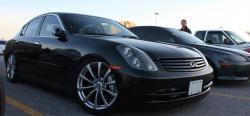
The front crash sensor is located on a bracket right in front of the radiator, not on the bumper. If you hit something with enough impact to jar that sensor, it will deploy the bags. It doesn't matter if the bumper was touched or not. The front cross member is attached to the frame of the car and hitting it with enough force will trigger the front crash sensor. It's not a defective part and nissan is not at any fault. Any make/model car will do the same thing.
My advice would be to contact the city. They might pay for it unless the cover was only a couple of inches high and you car is slammed.
My advice would be to contact the city. They might pay for it unless the cover was only a couple of inches high and you car is slammed.
The actual bumper, not the cover.
The damage that would be caused if that was hit from the bottom would likely include the engine oil pan, radiator and lower mount, control arms, etc, etc.
It could go either way, without knowing more or seeing pics it's hard to say. But my first impression is that this ish should never have set off an air bag.
Who knows.
Last edited by TunerMax; May 28, 2012 at 12:48 PM.

In what way is this mounted to the bumper?

Also how would the oil pan, radiator, etc. get damaged when the cross member the lower than them?

Also how would the oil pan, radiator, etc. get damaged when the cross member the lower than them?
Last edited by psycobusa; May 28, 2012 at 01:02 PM.

Yes, of course you're right, what in the fuak was I thinking about.
As for the sensor going off, regardless, still shouldn't happen, but of course it's not impossible.
One thing all air bag systems share in common are crash sensors. In theory, an air bag is only supposed to deploy in a frontal collision that is severe enough to trigger the control electronics, or in some cases a mechanical firing pin.
Most car companies say a vehicle has to experience an impact that generates at least 7 G's of force before it will trigger the air bag. For most vehicles, this would be the equivalent of hitting a solid barrier at 12 to 15 mph, or hitting another vehicle at a speed of about 25 mph. In reality, the air bag may deploy at higher or lower speeds.
Air bags also are not supposed to go off in rollovers or side or rear collisions, but they sometimes do. Weird things can happen during an accident, and impact forces can be transmitted in such a way that the air bag sensors are tricked into thinking a frontal collision is occurring when in fact it really is not. Of course, in such situations the air bag does nothing to protect the occupant because it is only designed to protect during frontal collisions
Most car companies say a vehicle has to experience an impact that generates at least 7 G's of force before it will trigger the air bag. For most vehicles, this would be the equivalent of hitting a solid barrier at 12 to 15 mph, or hitting another vehicle at a speed of about 25 mph. In reality, the air bag may deploy at higher or lower speeds.
Air bags also are not supposed to go off in rollovers or side or rear collisions, but they sometimes do. Weird things can happen during an accident, and impact forces can be transmitted in such a way that the air bag sensors are tricked into thinking a frontal collision is occurring when in fact it really is not. Of course, in such situations the air bag does nothing to protect the occupant because it is only designed to protect during frontal collisions
To prevent false deployments that might result from bumping into objects or a slow speed fender bender, most air bag systems also have one or two "safety" or "arming" sensors which are usually located inside the passenger compartment (under the dash or seat, in the airbag control module, or in the steering wheel air bag module). The safety sensor will not allow the bag to deploy unless it also experiences a certain rate of deceleration (usually less than that of the crash sensors).
If both the crash sensors and safety sensor(s) are triggered by a collision, then and only then does the electronic control module say okay and ignite the air bag inflator. It does this by applying voltage to the "squib" inside the sealed inflator. The squib sets off the sodium azide pellets inside the inflator, which produce harmless nitrogen gas as they explode. The gas rushes through a filter that traps any unburned particles of propellant and helps cool the gas, and forces the bag to burst from its housing and unfurl in 30 to 55 milliseconds (less time than it takes to blink your eyes).
If both the crash sensors and safety sensor(s) are triggered by a collision, then and only then does the electronic control module say okay and ignite the air bag inflator. It does this by applying voltage to the "squib" inside the sealed inflator. The squib sets off the sodium azide pellets inside the inflator, which produce harmless nitrogen gas as they explode. The gas rushes through a filter that traps any unburned particles of propellant and helps cool the gas, and forces the bag to burst from its housing and unfurl in 30 to 55 milliseconds (less time than it takes to blink your eyes).


^ Air Bag systems are complex, The accident the OP had met enough criteria to deploy the airbags. There are many things we don't know about. They went off for a reason, and yea sometimes they do go off when they dont need to but according to how the air bag system was programmed at the time of instillation it met the Criteria to deploy them. This is something that research keeps improving.
Here is from the Manual

Here is from the Manual
The supplemental front air bags ordinarily
will not inflate in the event of a
side impact, rear impact, rollover, or
lower severity frontal collision. Also,
the front passenger air bag will not inflate
if the passenger air bag status
light is lit. Always wear your seat belts
to help reduce the risk or severity of injury
in various kinds of accidents.
will not inflate in the event of a
side impact, rear impact, rollover, or
lower severity frontal collision. Also,
the front passenger air bag will not inflate
if the passenger air bag status
light is lit. Always wear your seat belts
to help reduce the risk or severity of injury
in various kinds of accidents.
The driver and front passenger seat
belt buckles are equipped with sensors
that detect if the seat belts are fastened.
The air bag system monitors the
severity of a collision and seat belt usage
then inflates the air bags. Failure
to properly wear seat belts can increase
the risk or severity of injury in
an accident.
belt buckles are equipped with sensors
that detect if the seat belts are fastened.
The air bag system monitors the
severity of a collision and seat belt usage
then inflates the air bags. Failure
to properly wear seat belts can increase
the risk or severity of injury in
an accident.
The INFINITI air bag system has dual
stage inflators for both the driver and
passenger air bags. The system monitors
information from the crash zone sensor,
the diagnosis sensor unit, seat belt
buckle switches, occupant classification
sensor (weight sensor) and passenger
seat belt tension sensor. Inflator operation
is based on the severity of a collision
and whether the seat belts are being
used. For the front passenger, it additionally
monitors the weight of an occupant or
object on the seat and seat belt tension.
Based on information from the sensors,
only one front air bag may inflate in a
crash, depending on the crash severity
and whether the front occupants are
belted or unbelted.
stage inflators for both the driver and
passenger air bags. The system monitors
information from the crash zone sensor,
the diagnosis sensor unit, seat belt
buckle switches, occupant classification
sensor (weight sensor) and passenger
seat belt tension sensor. Inflator operation
is based on the severity of a collision
and whether the seat belts are being
used. For the front passenger, it additionally
monitors the weight of an occupant or
object on the seat and seat belt tension.
Based on information from the sensors,
only one front air bag may inflate in a
crash, depending on the crash severity
and whether the front occupants are
belted or unbelted.



Also if your that low and if you are going to look for money I'd make sure your car meets your states code (ie minimum height for headlights...all the min height laws) And start taking pics of everything.

Registered User
Joined: Jun 2012
Posts: 11
Likes: 5
Guys, the sensors are accelerometers. Nothing has to "hit" them to make them activate. If they register massive deceleration then they trigger (like a temporary stop from hitting a pothole). The software only decides whether to fire the air bags if one or both of them register a critical reading. I have no idea how Nissan judges those. My G35 fired airbags when I hit a deer at 70mph and that thing didn't hit the bumper at all - it went under the hood through the grill and exploded on my windshield while jumping.
If his car stopped suddenly when hitting the manhole cover, even briefly, it could have been enough to simulate a front end accident. Airbag sensors are not location-dependent anymore, and for good reason: if you don't hit the sensor, you don't get an airbag. They are now unidirectional acceleration dependent. If your speed decelerates an unacceptable amount in a very short time - the sensors trigger.
I'm guessing it was a pretty hard hit, and it had absolutely nothing to do with what was in front of his car. I'm also guessing whatever part slowed it down that much is seriously hurting right now.
Second note: if the car "bounced" - that could also be attributed to a trigger. Extreme acceleration upwards could be interpreted as a frontal crash as the car would be lifted off the ground. Again, that's up to Nissan's software.
If his car stopped suddenly when hitting the manhole cover, even briefly, it could have been enough to simulate a front end accident. Airbag sensors are not location-dependent anymore, and for good reason: if you don't hit the sensor, you don't get an airbag. They are now unidirectional acceleration dependent. If your speed decelerates an unacceptable amount in a very short time - the sensors trigger.
I'm guessing it was a pretty hard hit, and it had absolutely nothing to do with what was in front of his car. I'm also guessing whatever part slowed it down that much is seriously hurting right now.
Second note: if the car "bounced" - that could also be attributed to a trigger. Extreme acceleration upwards could be interpreted as a frontal crash as the car would be lifted off the ground. Again, that's up to Nissan's software.

Thread
Thread Starter
Forum
Replies
Last Post
Learned Hand
G35 Sedan V35 2003-06
1
Oct 1, 2015 09:02 AM
master111
G35 Coupe V35 2003 - 07
2
Sep 25, 2015 08:32 PM
