

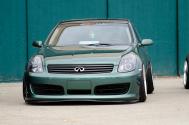
Why do manufacturers make the offset on almost all vehicles such that it results in the 'tucked' look? Most agree that the 'flush' appearance looks better, more aggressive, etc...so why not do it the right way in the first place?
I've noticed that even most of the exotic cars have the 'tucked' look.
Is the OEM tucked appearance better for handling or something that its on all cars or what?
I've noticed that even most of the exotic cars have the 'tucked' look.
Is the OEM tucked appearance better for handling or something that its on all cars or what?


Registered User
I would say that, for "normal" price range cars, VW/Audi's seem to have the very best fitments from the factory.

Registered User
probably because it costs less with very little affect to the car's intended use.

Registered User
because you have to remember most people who buy cars dont care much about "fiment" and they want to make sure when you go over a bump or the shocks rebound with a far full of people there will be no rubbing issues... most cars have sunken wheels... its just how they make cars. BMW have some what good fitment, but the G35 lord the rears stock are so sunk in, what happened ?

Registered User
Maybe it has to do with the aerodynamics, lower coefficient drag in wind tunnel testing. Either way it looks like poop.

Registered User
it can be achieved two ways, either a long wheel base or wide wheels, both cost more to produce.

Former G35driver Vendor
ShanesG
Former G35driver Vendor
close
Nov 24, 2020
- Join DateSep 2007
- LocationPasadena
- Posts:23,550
-
iTrader Positive Feedback100
-
iTrader Feedback Score(84)
-
Likes:106
-
Liked:335 Times in 187 Posts
YEAH THEY COULD HAVE MADE THE OEM 19 OFFSETS A lil BETTER!

Registered User
I'd hate to bring a thread back from the dead, but irishsig has it exactly right. I was looking for an answer to this myself when I stumbled upon this thread and did some research.
The G was advertised as a very aerodynamic vehicle, zero lift and a low coefficient of drag.
The flat underbody helps the zero lift.
And the wheels tucked in help reduce drag due to the disturbance caused by the spinning wheels. If the fenders extend further than the face of the wheel, then the air passing won't "see" this turbulence. That's why cars modified for hypermiling have spokeless (satellite dish) wheels and sometimes even covers over the wheel arch.
Keeping the wheel arches open help performance by creating a low pressure area directly outside of the spokes, helping to cool down brakes.
These concepts were used when designing the R34 GTR, as well as other more-pure sports cars with aggressive and boxy fender bulges.
The G was advertised as a very aerodynamic vehicle, zero lift and a low coefficient of drag.
The flat underbody helps the zero lift.
And the wheels tucked in help reduce drag due to the disturbance caused by the spinning wheels. If the fenders extend further than the face of the wheel, then the air passing won't "see" this turbulence. That's why cars modified for hypermiling have spokeless (satellite dish) wheels and sometimes even covers over the wheel arch.
Keeping the wheel arches open help performance by creating a low pressure area directly outside of the spokes, helping to cool down brakes.
These concepts were used when designing the R34 GTR, as well as other more-pure sports cars with aggressive and boxy fender bulges.
Registered User
1. 2 years olds
2. These cars are slow who cares about drag and lift.
2. These cars are slow who cares about drag and lift.

Registered User
Quote:
2. These cars are slow who cares about drag and lift.
+1 It's not like we're driving around in a Ferrari GTB or a AMG SL65 that hauls azzzzzzzzzz.Originally Posted by 4DGS
1. 2 years olds2. These cars are slow who cares about drag and lift.
Registered User
I can completely respect these opinions, but the effects of aero can be seen as low as 60mph. Our cars also don't perform too poorly at the track. These were the advertised selling points of our car, and hence the reason why we have a tucked appearance. I'm just trying to answer the OP's (and anyone else who might have been wondering the same thing and searched, like i did) question. 
Of course, making ourselves like it more is what modding is all about
Of course, making ourselves like it more is what modding is all about
