


What paint to use on Rotors??


What paint to use on Rotors??
Ordered some cross-drilled rotors that'll I'll be installing hopefully next week. Was planning on painting them first in order to avoid that nasty rust problems most rotors have after some use. Just wondering what's the best paint to use? Do I need to prime them first?? Any help would be greatly appreciated!




Originally Posted by BKZJAYY718
i never seen rotors painted, but you damn sure could be the first to try lol
Trending Topics


I've seen ricers with their rotors painted bright neon orange... neon green... and once yellow. Don't paint your rotors. If anything, it'll probably reduce your stopping power and end up killing you.


you can use the standard 500-deg rated spray cans of engine or brake caliper paint, but I usually go for the ceramic engine paint which is 1200-1500-deg if I recall correctly.
Some directions for you (at your own risk):
-Spray new rotors with brake parts cleaner, use paper towel to help with any extra grease/oil removal, let dry for 5-mins.
-I suggest doing one side at a time, no need to rush if you can avoid it. Tape off the braking surface of the rotor with painters tape (compare against old rotors).
-Paint even coats, let dry 10-mins between each coat and then re-apply until happy.
-Leave the previously taped side still taped and then do the other side now, you can also spray the width of the rotor, around the vanes.
-When finished, peal off tape and take rag or paper towel soaked with brake parts cleaner and wipe the braking surface to get off any tape residue. if you spray the painted rotors with the cleaner it might ruin your paint.
-Let paint cure for 24-hrs before you go heating them up beyond normal driving. If you cant wait that long, wait at least an hour, they will be dry to the touch 30-45mins after the last coat (if you use gloss paint wait longer).
Some directions for you (at your own risk):
-Spray new rotors with brake parts cleaner, use paper towel to help with any extra grease/oil removal, let dry for 5-mins.
-I suggest doing one side at a time, no need to rush if you can avoid it. Tape off the braking surface of the rotor with painters tape (compare against old rotors).
-Paint even coats, let dry 10-mins between each coat and then re-apply until happy.
-Leave the previously taped side still taped and then do the other side now, you can also spray the width of the rotor, around the vanes.
-When finished, peal off tape and take rag or paper towel soaked with brake parts cleaner and wipe the braking surface to get off any tape residue. if you spray the painted rotors with the cleaner it might ruin your paint.
-Let paint cure for 24-hrs before you go heating them up beyond normal driving. If you cant wait that long, wait at least an hour, they will be dry to the touch 30-45mins after the last coat (if you use gloss paint wait longer).

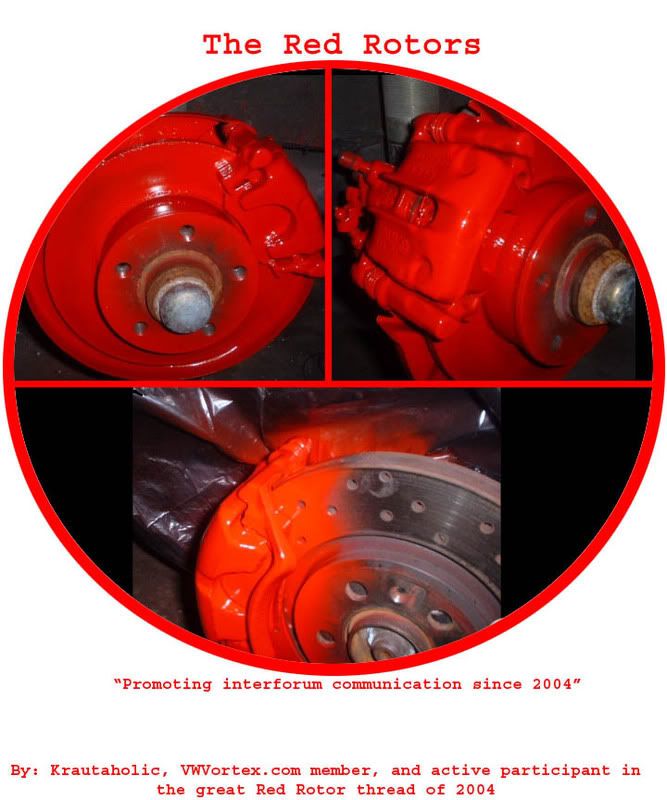

The reason behind painting rotors, especially ones that are drilled and slotted, is to prevent rust. The paint comes off of the swept surface the first time you apply the brakes and is quickly eaten off of the brake pad. You are left with a painted surface on the unswept area. I don't think he is talking about painting them red or any other color (at least i hope he isn't), but black which is not noticed behind the wheels. Trying to prevent rust isn't rice.

Originally Posted by 5150DS
The reason behind painting rotors, especially ones that are drilled and slotted, is to prevent rust. The paint comes off of the swept surface the first time you apply the brakes and is quickly eaten off of the brake pad. You are left with a painted surface on the unswept area. I don't think he is talking about painting them red or any other color (at least i hope he isn't), but black which is not noticed behind the wheels. Trying to prevent rust isn't rice.
Pronunciation:
\ˈjōk\
Function:
noun
Etymology:
Latin jocus; perhaps akin to Old High German gehan to say, Sanskrit yācati he asks
Date:
1670
1 a: something said or done to provoke laughter ; especially : a brief oral narrative with a climactic humorous twist b (1): the humorous or ridiculous element in something (2): an instance of jesting : kidding <can't take a joke> c: practical joke d: laughingstock
2: something not to be taken seriously : a trifling matter <consider his skiing a joke — Harold Callender> —often used in negative constructions <it is no joke to be lost in the desert>